

Replacing every water pipe in your home doesn’t mean moving your family into a hotel for two weeks. Most Calgary homeowners naturally worry about how long does poly b replacement take, dreading days without running water and weeks of living inside an open construction zone. That anxiety is completely understandable. Your home is your sanctuary, and the thought of tradespeople opening walls while your daily routine grinds to a halt can feel overwhelming.
The reality is far more manageable when you separate active pipe fitting from the drywall curing stages. For a standard home, plumbers are actively running new lines for only one to two business days, and domestic water is safely pressurized and restored every evening. This guide breaks down the realistic day-by-day schedule from floor protection to finished paint, showing you exactly what to expect so you can organize work routines, family life, and pet care with confidence.
Key Takeaways
- Understanding how long does poly b replacement take begins with separating the project into two distinct phases: active plumbing rough-in followed by multi-stage drywall restoration.
- Active repiping requires between two and four business days on site, with plumbers isolating lines so domestic water service is safely restored each evening.
- Drywall patching, mud drying, texturing, and painting add three to five business days to return your living spaces to original condition.
- Key home variables like finished basement ceilings, multi-storey layouts, and total bathroom fixture counts directly influence your overall completion schedule.
- Simple preparation steps, including clearing vanity cupboards and moving delicate furniture away from plumbing stacks, prevent avoidable delays on day one.
Typical Poly B Replacement Timelines: A Quick Breakdown
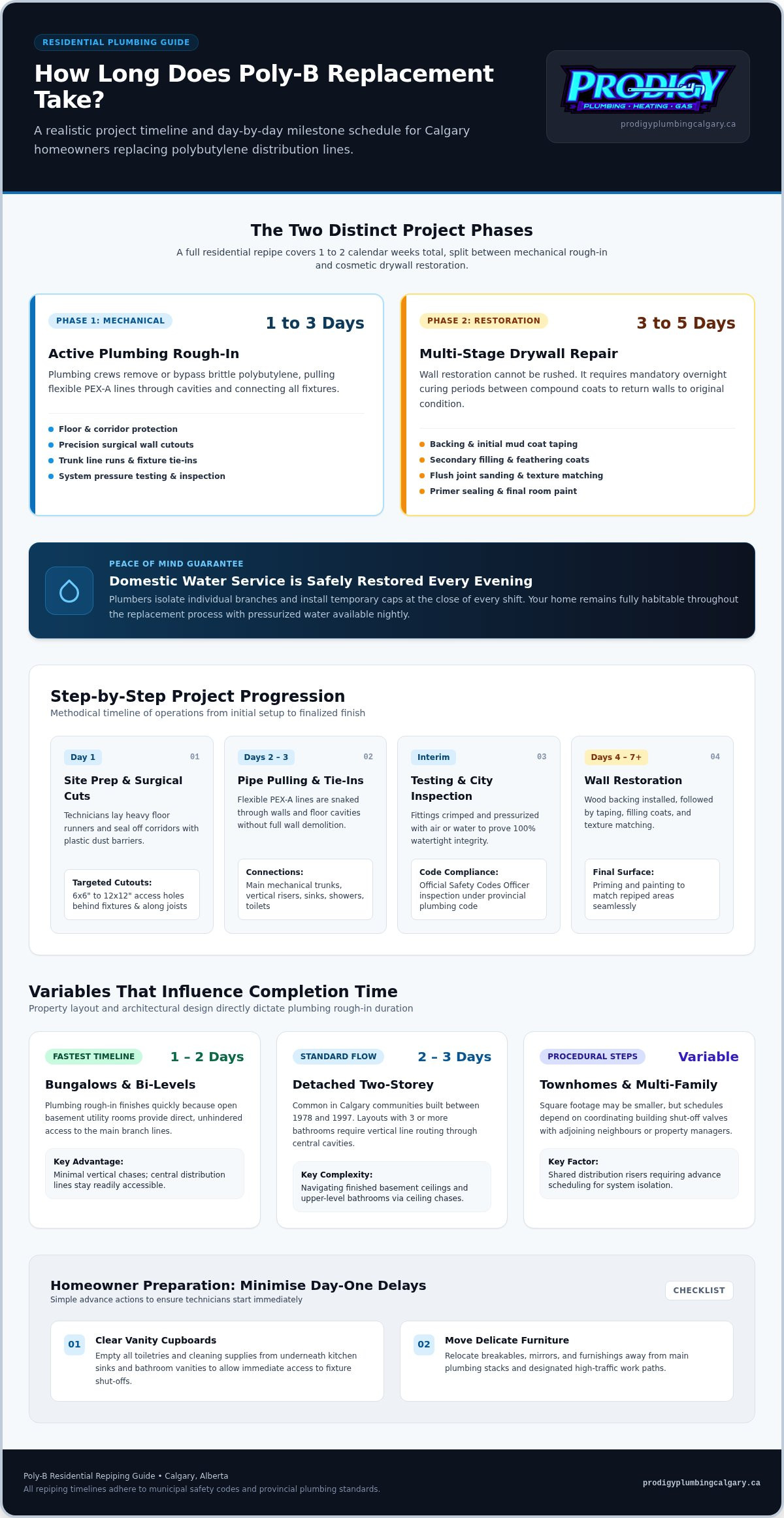
When asking how long does poly b replacement take, the answer depends on dividing the project into two separate trades: plumbing installation and drywall restoration. Many contractors quote a generic one-week span without explaining where those days actually go. In reality, the active pipe replacement usually takes between one and three business days, while wall repairs require another three to five days to finish properly.
The total duration from laying the first drop sheet to finished paint typically covers one to two calendar weeks. Homes remain completely habitable throughout this entire window. Plumbers isolate individual branches and install temporary caps, ensuring your main domestic water service is pressurized and restored at the end of every work day.
Plumbing Rough-In vs. Drywall Restoration Hours
Plumbing crews work continuously on site to remove or bypass brittle polybutylene piping and thread durable PEX-A lines through floors and wall cavities. This hands-on mechanical phase moves quickly. Once lines are tested and municipal safety inspections are booked, the drywall restoration begins.
Drywall repair cannot be rushed. It demands several visits spaced out over multiple days:
- Backing and taping: Installing wood backing and embedding tape in the initial mud coat.
- Filling and feathering: Applying secondary compound layers with mandatory overnight curing periods.
- Sanding and texturing: Smoothing joints flush and matching original wall or ceiling textures.
- Priming and painting: Sealing raw patches so repiped sections blend invisibly with your rooms.
Single-Family Homes vs. Condos and Townhomes
Property architecture directly alters the job clock. Detached two-storey homes in communities built between 1978 and 1997 often require extensive vertical routing through central floor cavities and ceiling chases, taking up to three active plumbing days for layouts with three or more bathrooms. Bungalows and bi-levels move faster, often wrapping plumbing rough-ins within one to two days because open basement utility rooms give direct access to the main branch lines.
Townhomes and multi-family units follow a different schedule. While the physical square footage may be smaller, coordinating building shut-off valves with adjoining neighbors or property management adds procedural steps. Clarifying these layout factors early ensures you know exactly how long does poly b replacement take for your specific floor plan.
Day-by-Day Stages of a Complete Residential Repiping Project
A systematic plan keeps repiping orderly and predictable. When considering how long does poly b replacement take on a practical level, breaking the workflow down into daily milestones helps you plan around tradespeople in your home. Professional crews follow a set sequence designed to protect your living areas while methodically updating your distribution system.
Site Preparation and Precision Access Cuts
Day one focuses on protection and targeted access. Plumbers begin by laying heavy floor runners and setting up plastic dust barriers along high-traffic corridors. Instead of tearing down broad sections of wall, technicians make small, surgical cutouts measuring roughly 6×6 or 12×12 inches directly behind fixtures or along joist bays. This measured approach keeps structural framing intact, confines drywall dust, and dramatically reduces patching time later in the week.
Pipe Pulling, PEX Installation, and Fixture Tie-Ins
Days two and three center on running lines. Flexible PEX-A pipe is snaked through floor cavities and stud spaces, replacing old lines without opening entire chases. Technicians run main distribution trunks from your mechanical room, establish vertical risers, and make dedicated tie-ins at every sink, shower, and toilet. If you want to understand why these grey lines fail over time, reviewing this Poly-B Piping in Calgary Guide offers helpful technical context on chlorine degradation and fitting stress. Homeowners seeking a seamless transition can turn to experienced professionals for full poly b replacement to keep every step organized from start to finish.
Pressure Testing, City Inspections, and Wall Close-Up
Once all fittings are crimped, the new system is sealed and pressurized with air or water to confirm total watertight integrity. In Calgary, replacing supply lines requires an official permit and inspection by a Safety Codes Officer under the provincial plumbing code, as outlined in the Government of Alberta Poly-B safety advisory. Once the inspector signs off, wall restoration begins:
- Backing and installation: Securing solid wood backing blocks and screwing original drywall plugs into place.
- Taping and mud coats: Applying consecutive layers of joint compound, letting each layer dry completely.
- Texture matching and painting: Replicating existing knockdown or orange-peel finishes, followed by clean paint blending.
By mapping out these clear stages, knowing how long does poly b replacement take shifts from an open-ended guess into a structured, stress-free schedule.
Variables That Speed Up or Lengthen Your Poly-B Project
Every home has its own structural quirks that impact the work calendar. While standard timelines offer a helpful benchmark, discovering precisely how long does poly b replacement take in your residence comes down to framing accessibility, mechanical routing, and interior finishes. An open layout with simple runs moves considerably faster than a multi-level floor plan with obstacles behind every wall.
Property Size, Storeys, and Fixture Density
The total volume of plumbing connections dictates how quickly new lines can be stubbed out. A two-bathroom bungalow with clustered plumbing back-to-back can often be rough-plumbed in two days. In contrast, a four-bathroom two-storey home with an ensuite and separate laundry requires significant line chasing across floor assemblies.
Additional water points also extend the active installation hours:
- Basement wet bars and utility sinks
- Outdoor frost-free hose bibbs
- Dedicated lines for refrigerator ice makers and water dispensers
- Dual shower heads and standalone soaker tubs
Each additional branch means another series of joist penetrations, connections, and pressure verifications before inspection.
Basement Development and Ceiling Finishes
Access below the main floor is often the biggest wild card. Homes with unfinished mechanical spaces allow technicians to walk right in, map the main distribution trunks, and run new PEX-A lines without cutting a single sheet of drywall. When a basement is fully developed, technicians must work around finished drywall ceilings, bulkheads, and existing HVAC ductwork. Navigating these obstructions requires careful planning to locate existing distribution loops, which is why reviewing the Alberta Municipal Affairs advisory on Poly-B piping helps illustrate how these systems were initially installed throughout Alberta basements.
Ceiling and wall textures also heavily influence the final repair phase. Flat drywall surfaces are straightforward to tape, sand, and paint. In comparison, matching custom knockdown or acoustic popcorn textures on ceiling patches takes an experienced drywall tradesperson extra time and patience. Custom paint colours or older walls that require whole-room blending to prevent patchy sheen differences can add one or two days to the painting schedule.
Factoring in your home’s layout, fixture count, and basement finishes gives you an accurate answer for how long does poly b replacement take from start to finish.
Living at Home During Repiping: Daily Water Access and Disruption
You do not need to pack bags or spend money on hotel accommodations while your home is being repiped. A major concern for families evaluating how long does poly b replacement take is whether they can actually live comfortably inside their residence during the project. The answer is yes. With a methodical trade approach, the physical intrusion on your personal living space remains contained, predictable, and manageable.
Managing Daily Water Shut-Off Windows
Water service is suspended only during active daytime work hours, typically between 8:30 AM and 4:30 PM. Plumbers isolate the specific zones where they are actively working, install temporary caps on open lines, and recharge the main domestic lines before leaving every afternoon. That means your evening showers, meal prep, and bedtime routines carry on normally.
Preparing a few essentials before technicians arrive each morning ensures total peace of mind throughout the day:
- Fill a clean kettle and several water pitchers for drinking and cooking needs.
- Keep a bucket or utility jug filled with water to manually flush a main-floor toilet if required during the day.
- Run dishwashers and laundry cycles the evening before so appliances aren’t needed during working hours.
Noise, Dust Control, and Household Logistics
Opening wall access points and pulling PEX tubing creates intermittent noise. Tools like reciprocating saws, oscillating multi-tools, and cordless drills operate periodically as technicians free old brackets and secure new pipe clips. Reputable plumbers control dust by running HEPA-filtered negative air scrubbers and sealing doorways with zippered plastic containment barriers. These precautions keep fine drywall particulate strictly confined to active work corridors.
Planning household logistics makes the multi-day transition smooth. If you work from home, establishing a quiet desk in a bedroom away from primary bathrooms prevents disruption during team conference calls. Families with dogs or cats should secure pets in comfortable, closed rooms on levels where no plumbing work is scheduled. Trade technicians frequently move materials through exterior doorways, so keeping animals safe indoors prevents accidental escapes.
If you are ready to update your residential plumbing without unnecessary household chaos, consult the experienced Journeymen at Prodigy Mechanical to review your home’s setup. A clear plan ensures your questions about how long does poly b replacement take are answered with dependable, day-by-day certainty.
Preparing Your Home to Minimise Poly-B Replacement Delays
Advance staging by the homeowner directly dictates how quickly trade crews can move through a house. When calculating how long does poly b replacement take, project length is often shaved down simply by eliminating morning access hurdles. Taking an hour or two before arrival day to clear key paths allows Journeyman plumbers to lay drop runners and start running new PEX lines immediately.
Clearing Strategic Plumbing Access Points
Plumbing manifolds and vertical risers are tucked behind the fixtures you use every day. Clearing out personal items ahead of time protects your belongings and grants technicians immediate, unobstructed access to stop valves and pipe chases.
Focus your preparation on these high-priority zones:
- Vanity cabinets: Empty toiletries, cleaning supplies, and baskets from beneath all kitchen, ensuite, and powder room sinks.
- Mechanical access: Move storage boxes, sports equipment, and shelving units at least one metre away from your main incoming water meter and shut-off valve.
- Water heating equipment: Ensure an open, clean perimeter around your hot water system. If your tank is also approaching the end of its service life, consult this Hot Water Tank Replacement Calgary Guide to see whether coordinating equipment upgrades alongside repiping makes practical sense.
- Wall perimeters: Shift delicate furniture, dressers, and freestanding mirrors away from drywall surfaces that share plumbing stacks with adjacent bathrooms.
Coordinating with Licensed Calgary Plumbers
A successful repiping project relies on thorough communication before the first tool touches your wall. Booking an on-site consultation gives your contractor the chance to trace existing branch runs, inspect crawl spaces or drop ceilings, and establish clean material pathways from exterior doors to the mechanical room. Taking time to inspect these details in advance prevents unexpected scheduling pauses once work begins.
Homeowners should always verify that their plumbing contractor carries active City of Calgary licensing, full liability insurance, and WCB coverage. Choosing experienced tradespeople who understand local building practices ensures your installation satisfies municipal inspection requirements without delays. For a wider look at preventative home system care, explore the Complete Plumbing Guide for Calgary Homeowners. Taking these straightforward preparatory steps ensures you know exactly how long does poly b replacement take, keeping your project moving strictly on time.
Plan Your Calgary Home Repiping with Confidence
Replacing aging polybutylene lines protects your investment and ensures your property remains fully insurable. When evaluating how long does poly b replacement take, remember that active mechanical installation only requires two to four business days, followed by methodical drywall curing. Plumbers isolate work areas so your domestic water service is safely restored every evening, allowing your family to stay comfortable in your own space.
Prodigy Mechanical brings over 15 years of trade plumbing experience to residential properties across Calgary. Every job is completed by licensed, insured Journeyman plumbers dedicated to tidy work sites, clear communication, and reliable per-job service. You don’t have to face repiping with uncertainty or disruption. Request an on-site Poly-B assessment with Prodigy Mechanical today and take the first step toward lasting plumbing protection.
Frequently Asked Questions
Do I have to leave my home while the Poly-B pipes are being replaced?
No, you do not need to move out or book external accommodations during repiping. Experienced plumbers isolate individual sections and keep one functioning bathroom operational as long as possible during the day. Most importantly, main domestic water lines are re-pressurized and restored before technicians pack up each afternoon, allowing your family to sleep, cook, and bathe comfortably at home throughout the entire project.
How long will my water service be shut off each day during the repipe?
Domestic water is turned off only during active work hours, typically between 8:30 AM and 4:30 PM. Plumbers shut down branch lines to make new connections, then test and recharge the system before leaving. If you are wondering how long does poly b replacement take to impact daily routines, the water outage is strictly confined to daytime hours, leaving evenings and mornings completely normal.
Can plumbers replace Poly-B pipes without cutting into my drywall?
No, complete replacement requires some drywall openings to reach supply valves, risers, and manifolds. Professional installers don’t demolish whole sheets of board. Instead, they make small, targeted access cuts measuring 6×6 or 12×12 inches behind toilets, vanities, and mechanical spaces. Flexible PEX-A pipe is then fished between studs, minimizing overall drywall damage and speeding up final patching.
How long does a two-bathroom Calgary bungalow take compared to a two-storey home?
A standard two-bathroom bungalow usually requires one to two days of active plumbing work because open basement utility lines offer direct access. A two-storey home with three or four bathrooms typically takes two to three days. Technicians must route vertical risers through upper-level floor joists and wall cavities, which adds extra mechanical labor before calling in drywall restoration crews.
Will replacing Poly-B affect my home insurance coverage timeline immediately?
Yes, your coverage terms improve as soon as your City of Calgary plumbing permit receives official sign-off. Many Alberta insurers enforce high water-damage deductibles or give homeowners a 30- to 60-day window to replace polybutylene. Providing your insurer with a closed municipal safety inspection certificate and your contractor’s invoice immediately satisfies underwriting requirements and eliminates Poly-B coverage exclusions.
What happens if a leak occurs during the replacement process?
Licensed Journeyman plumbers actively control risk by working on isolated, fully drained pipe branches. Technicians keep dedicated shut-off valves and repair fittings ready on site for unexpected line issues. Before reconnecting domestic supply lines each evening, the entire newly installed PEX-A layout undergoes sustained pressure testing with air or water to confirm every joint is watertight before turning the main supply back on.
How many days does the drywall patching and texturing phase take to dry?
Drywall restoration generally spans three to five business days following the mechanical inspection. While the physical patching and sanding takes only a few hours of hands-on labor per visit, each layer of joint compound requires a full overnight curing window. That step-by-step drying cycle ensures tape joints stay flat, ceiling textures match original patterns, and finished paint dries without flashing.