

In 2026, owning a home with poly b piping is no longer just a maintenance concern; it’s a direct threat to your property’s insurability and resale value. You likely bought your home to build equity and feel secure, but the constant worry of a sudden, catastrophic leak makes that peace of mind feel out of reach. It’s frustrating to face rising insurance premiums or the threat of policy cancellation because of the plumbing materials hidden behind your drywall.
This guide provides the clarity you need to move forward with confidence. You’ll learn how to identify these pipes, why Calgary’s specific climate and water chemistry accelerate their failure, and the most efficient path toward a permanent solution. We’ll walk through the current insurance landscape in Alberta and outline a roadmap for replacement that protects your property without unnecessary destruction.
Key Takeaways
- Learn how to identify poly b piping by checking your main water shut-off or mechanical room for characteristic grey flexible tubing.
- Understand the chemical reaction between chlorine and polybutylene that causes these pipes to become brittle and prone to failure over time.
- Navigate the 2026 insurance landscape in Alberta to avoid policy cancellations and high premium surcharges associated with older plumbing materials.
- Discover a surgical replacement process that uses modern PEX materials while minimizing the need for extensive drywall repairs and home disruption.
- Establish a clear plan to protect your home’s resale value and ensure long-term plumbing reliability for your property.
What is Poly-B Piping and Why is it Common in Calgary?
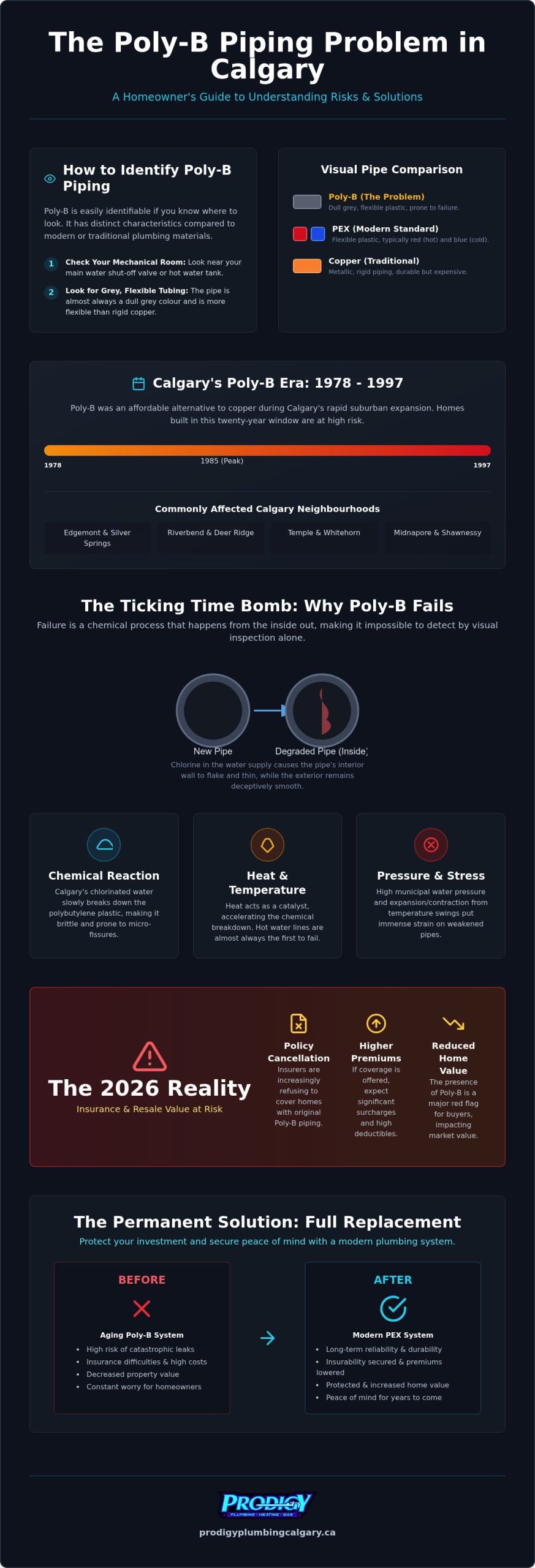
Poly-B is the common name for Polybutylene (Poly-B), a flexible grey plastic resin used for domestic water piping. Between 1978 and 1997, it was the primary choice for residential plumbing across Canada. If you look near your water meter or hot water tank and see grey, flexible tubes rather than copper or white PEX, you likely have poly b piping. While it appeared to be a robust solution at the time, the National Plumbing Code of Canada officially removed it from their approved standards in 2005 due to high failure rates. It’s now widely recognized as a material with a finite lifespan that often ends in costly water damage.
The History of Polybutylene in Alberta
The shift toward plastic piping in Alberta was driven by economics. In the late 1970s, the price of copper reached record highs, making traditional plumbing expensive for the massive suburban developments planned for Calgary. Developers needed a material that was affordable and fast to install. Poly-B fit the bill perfectly. It was flexible enough to be snaked through floor joists without the need for numerous joints and solder points, which reduced labour costs and installation time. This efficiency helped fuel the rapid growth of Calgary’s outer rings during the 80s and 90s. However, the initial promise of a maintenance-free system didn’t hold up. As the pipes aged, the material’s vulnerability to common water treatment chemicals became clear. By 1997, the use of poly b piping in new construction had largely vanished across the province.
Common Calgary Neighbourhoods with Poly-B
Your risk level is tied directly to when your community was developed. Calgary’s “Poly-B belt” includes many established suburbs built during the peak installation window of 1985 to 1997. We frequently see these systems in neighbourhoods such as:
- Edgemont and Silver Springs in the Northwest
- Riverbend and Deer Ridge in the Southeast
- Temple and Whitehorn in the Northeast
- Midnapore and Shawnessy in the South
Homes built after 1997 are generally safe because the industry had largely transitioned to PEX (cross-linked polyethylene) by that time. If you aren’t sure when your home was built, you can find the date on your property tax assessment or by checking the date stamp inside your electrical panel. Any home built in that specific twenty-year window should be inspected. Understanding your home’s history is the first step toward protecting your property from the quiet degradation of aging plastic pipes.
Why Poly-B Fails: The Science Behind the Ticking Time Bomb
The primary reason poly b piping fails isn’t due to poor installation or physical wear; it’s a matter of chemistry. Polybutylene was designed to be flexible and inexpensive, but engineers didn’t fully account for how it would react with common water treatment chemicals over decades. This creates an “inside-out” degradation process. The interior wall of the pipe begins to flake and thin, while the outside remains smooth and grey. This deceptive appearance is why many Calgary homeowners are caught off guard by sudden, massive leaks that seem to come from nowhere.
Chlorine and Calgary Water Treatment
Calgary’s municipal water treatment is vital for public health, but it’s notoriously hard on polybutylene. The city uses chlorine as a primary disinfectant. When these oxidants flow through your home, they react directly with the plastic resin in the pipe walls. This chemical interaction causes the material to lose its plasticizers, making it brittle and prone to micro-fissuring. After 30 years of continuous exposure, the cumulative damage is often significant. The pipe eventually becomes so thin that it can no longer withstand the standard pressure of the city’s water system, leading to pinhole leaks or total bursts.
The Role of High Pressure and Temperature
Heat acts as a powerful catalyst for this chemical breakdown. The higher the water temperature, the faster the plastic loses its elasticity and structural integrity. This is the reason hot water lines almost always fail before cold water lines. If your hot water tank is set to a high temperature to compensate for a large family or a deep soaking tub, you’re likely accelerating the aging of your plumbing. Calgary’s environment adds another layer of stress. Our dramatic temperature swings, particularly during Chinook events, cause the plumbing to expand and contract frequently. This physical movement, combined with high municipal water pressure, puts immense strain on pipes that have already been weakened by chemical exposure.
We also need to distinguish between fitting failures and pipe failures. Many early Calgary homes used plastic fittings that were prone to cracking at the joints. While later installations used metal fittings to solve this specific issue, the pipe itself remains the weak link. If you’re concerned about the age of your system, a professional plumbing inspection can help you evaluate your risk level and plan for a more reliable future.
The 2026 Calgary Reality: Insurance and Resale Value
As of August 2026, the Alberta insurance market has taken a firm stance on homes containing poly b piping. Most major carriers now view these systems as an unacceptable risk. This shift is driven by the high cost of remediation. The average water damage event from a pipe failure now costs between C$15,000 and C$40,000 to repair. Because of these numbers, insurers are no longer willing to look the other way. If you own an older home in Calgary, you’re likely feeling the pressure of a hardening market that prioritizes modern materials over legacy plumbing.
Insurance Denials and Surcharges
It’s becoming common for Calgary homeowners to receive a “conditional renewal” notice. This is a formal letter stating that your policy will only stay active if you replace your plumbing within a specific timeframe, often 30 to 60 days. If you don’t comply, you may face a total denial of coverage. Other providers might offer a renewal but include a “Poly-B surcharge,” which significantly increases your monthly premiums. Perhaps most concerning is the trend of excluding water damage entirely. In this scenario, your policy remains active, but the insurer won’t pay a cent if a pipe bursts. This leaves you carrying the full financial weight of a potential disaster. When a pipe does fail suddenly, knowing how to reach emergency plumbing Calgary services can be the difference between a manageable repair and a total home restoration.
Don’t assume that a “grandfathered” policy protects you indefinitely. Many homeowners discover that planning a simple bathroom renovation or kitchen upgrade triggers a fresh inspection. Once the insurer realizes the home still has its original grey plastic pipes, they may demand an immediate upgrade before the project can proceed. This can derail your renovation timeline and lead to unexpected costs at the worst possible moment.
Selling a Home with Poly-B in Calgary
In the current 2026 real estate market, poly b piping is a major red flag on home inspection reports. Buyers are more educated than ever. They know that these pipes represent a looming expense and a hurdle for their own insurance approval. Consequently, most buyers will demand a “replacement credit” at the closing table. This credit is often higher than the actual cost of the work because it accounts for the perceived stress and the need for immediate action after move-in.
Proactively replacing your system before listing is usually the more profitable path. It removes a significant barrier to sale and allows you to market your property as “fully updated and insured.” When you provide a certificate of PEX replacement, you give potential buyers the peace of mind they need to make a firm offer. It transforms a major liability into a selling point, ensuring your home stands out for its reliability rather than its risks.
How to Identify and Monitor Your Plumbing System
If you suspect your home has poly b piping, you can verify it yourself with a quick visual inspection. You don’t need special tools to find the evidence. Start in your basement or utility room where the plumbing is most likely to be exposed. Following a systematic approach will help you determine the state of your system and whether you need to take immediate action.
- Step 1: Locate your main water shut-off valve. This is usually in the basement, often near the front of the house. The pipe entering the meter is often copper. The lines branching off it, however, might be grey plastic.
- Step 2: Check the mechanical room. Head to the area near your hot water tank and furnace. Look closely at the connections. This is the most common place to spot the characteristic grey tubing.
- Step 3: Inspect the colour of the fittings. If you see grey plastic elbows or tees secured with metal rings, that’s a classic Poly-B setup. If the fittings are copper or brass, the system might have been partially repaired, but the grey pipe itself remains the primary concern.
- Step 4: Look for “PB2110” markings. If you can find a clear section of pipe, look for the designation “PB2110” printed on the side. This is the definitive manufacturing code for polybutylene.
- Step 5: Watch for weeping. Look for white, crusty mineral deposits or green corrosion around the metal crimp rings. These are signs of slow, silent leaks that often precede a major burst.
Visual Cues: What to Look For
Poly-B has a specific look. It’s a dull, matte grey colour. Don’t confuse it with modern PEX, which is usually a brighter, more translucent white, or specifically coloured red and blue. In finished homes, these pipes are often hidden behind small plastic access panels in the ceiling or walls of the basement. If you see an access panel, pop it open and shine a flashlight inside. Seeing that grey matte finish is a clear indicator of what’s behind your walls. For a more detailed walkthrough of the identification process, our guide on how to identify and manage poly b plumbing in your Calgary home covers every visual cue and stamp marking you need to know.
Proactive Monitoring Tips
If you find poly b piping, you need to monitor it closely while you plan for replacement. Pay attention to the bends in the pipe. Over time, the plastic becomes brittle and develops tiny hairline cracks on the outside of the curve. You should also perform a water meter test. Turn off every tap and appliance in the house; then watch the dial on your water meter. If it moves at all, you have a leak somewhere in the system.
A single leak is a clear signal that the material has reached the end of its reliable life. We don’t recommend a “wait and see” approach once the first failure occurs. If a pipe bursts unexpectedly, having access to a trusted emergency plumbing Calgary professional ensures you can stop the damage quickly and protect your home. If you’ve found grey pipes and want an expert opinion, you can book a professional plumbing inspection to get a clear assessment of your home’s risk level.
Full Poly-B Replacement: The Prodigy Mechanical Process
Replacing poly b piping is a significant undertaking, but it shouldn’t be a chaotic experience. We’ve refined our process over 15 years to ensure your home remains functional and clean throughout the transition. The goal is to move from a high-risk system to a modern, reliable one with as little disruption as possible. By choosing a full replacement over a temporary patch, you’re investing in the long-term health of your property and securing your insurance eligibility for years to come.
The PEX Advantage
Modern PEX (cross-linked polyethylene) is the industry standard for a reason. Unlike the original poly b piping, PEX is chemically engineered to resist the chlorine and oxidants found in Calgary’s water supply. It doesn’t become brittle over time. We use high-quality PEX-a or PEX-b systems, which offer incredible flexibility. This flexibility allows us to snake lines through your walls and floors, significantly reducing the number of joints where leaks could potentially occur. Beyond safety, PEX is much quieter than plastic or copper. It absorbs the pressure changes that cause “water hammer,” resulting in a more peaceful home environment.
What to Expect During the Replacement
The biggest concern for most homeowners is the mess. We address this through a surgical approach to the work. Before any tools are touched, we safeguard your floors and furniture with drop cloths and protective barriers. We don’t tear down whole walls. Instead, we make small, strategic cuts in the drywall only where necessary to access the main lines and connection points. This precision makes the eventual patching and painting much faster and more affordable.
A typical Calgary home can usually be repiped in days rather than weeks. We work methodically, ensuring you have water service at the end of each day whenever possible. Once the new PEX lines are pulled and secured, we perform a rigorous pressure test to verify every connection. This phase also involves obtaining the necessary permits to ensure your home remains compliant with the Alberta Building Code. For many homeowners, it’s the perfect time to modernize other components. You might consider a hot water tank replacement Calgary to ensure your entire mechanical system is refreshed and operating at peak efficiency. This proactive step provides total peace of mind and simplifies your future maintenance needs. It’s also worth noting that aging plumbing systems in these older homes often contribute to slow drains and recurring clogs; if you’re experiencing those issues alongside your poly-b concerns, our guide on professional drain cleaning near me explains the root causes and lasting solutions available to Calgary homeowners.
Protect Your Calgary Property and Peace of Mind
Managing a home with poly b piping shouldn’t feel like waiting for a disaster to happen. The combination of Calgary’s water chemistry and the hardening insurance market in 2026 makes proactive replacement the only reliable path forward. Transitioning to modern PEX eliminates the risk of sudden water damage and ensures your property remains a valuable, insurable asset. This investment pays for itself through lower premiums and a smoother resale process when you decide to sell.
Prodigy Mechanical provides over 15 years of Calgary plumbing expertise. Our fully licensed and insured technicians specialize in a minimally invasive repiping process that respects your space and your schedule. We handle the technical details and permits so you don’t have to worry about the logistics. Book a Poly-B inspection with Prodigy Mechanical today to take the first step toward a worry-free home. You deserve the confidence that comes with a plumbing system built to last.
Frequently Asked Questions
Is Poly-B plumbing the same thing as PEX?
No, they’re entirely different materials. Poly-B is the older grey plastic that’s no longer approved by the national plumbing code. PEX is the modern, flexible replacement that’s specifically engineered to resist the chlorine damage that destroys older plastic lines. While they both belong to the plastic family, PEX is significantly more durable and is currently the trusted standard for all residential plumbing installations across Calgary.
How much does it cost to replace Poly-B in a standard Calgary home?
The total investment depends on several variables like the square footage of your home and the number of bathrooms. Accessibility is also a major factor; finished basements require more careful work than unfinished ones. Because every home is unique, we provide a detailed assessment to determine the scope of work. This ensures you get a clear understanding of the project requirements without any hidden surprises later on.
Will my insurance company cancel my policy if I have Poly-B?
It’s becoming a common reality in the Alberta market. Many insurers now require the full replacement of poly b piping as a condition for maintaining your home insurance policy. You might find your premiums rising or discover that your policy now excludes any water damage claims. In some cases, providers may deny coverage entirely for new home purchases until the plumbing is modernized to PEX.
Can I just replace the plastic fittings with copper ones instead of a full repipe?
No, replacing the fittings doesn’t solve the underlying problem. The pipe material itself is what degrades from the inside out when it’s exposed to municipal water treatment chemicals like chlorine. Even if you switch to copper or brass fittings, the grey pipe walls will continue to thin and become brittle over time. A full repipe is the only way to ensure your home remains safe and insurable.
How long does a typical Poly-B replacement take?
Most standard single-family homes in Calgary can be finished in three to five business days. We use a methodical approach to minimize disruption, making sure you have water service at the end of each work day. The exact timeline varies based on the complexity of your home’s layout and the number of fixtures. We prioritize efficiency to get your life back to normal as quickly as possible.
Does Poly-B pipe freeze and burst more easily than copper?
While Poly-B is more flexible than copper, it isn’t more resistant to damage. As the material ages and becomes brittle from chemical exposure, its ability to handle any expansion from freezing decreases significantly. When it does freeze, the weakened walls are much more likely to fail catastrophically compared to modern PEX. PEX is specifically designed to expand and contract safely, making it the much better choice for Calgary winters.
Should I buy a Calgary home if the inspection finds Poly-B?
You can certainly buy the home, but you should do so with a clear plan. Use the home inspection findings to negotiate a price reduction or a credit for the full replacement of the poly b piping. Most educated buyers in Calgary treat this as a necessary immediate upgrade. Addressing it before you move in is often the easiest way to handle the project and secure your insurance.
Is there a class-action settlement still available for Poly-B in Canada?
No, those settlement windows have been closed for a long time. The major Canadian class-action lawsuits related to polybutylene failures reached their claim deadlines years ago. Homeowners are now fully responsible for the costs associated with replacement and any remediation required after a leak. This is why we recommend a proactive approach to replacement before a failure occurs, as there are no longer any subsidies available.