

Last Tuesday, a homeowner in a lower-elevation Calgary community stepped into the shower only to be met with a stinging blast of water that felt more like a pressure washer than a relaxing routine. This sudden change often points to water pressure regulator problems Calgary residents encounter when their municipal supply isn’t properly managed. Whether it’s a high-pitched humming in your walls or a sudden drop in flow, these signs suggest your pressure-reducing valve is no longer doing its job.
We understand how unsettling it is to hear strange vibrations in your pipes or worry about the stress high pressure puts on your plumbing. You want your home to run reliably without the fear of hidden leaks or a spike in your utility bills. This guide provides the clarity you need to troubleshoot these issues and understand how Calgary’s unique water zones affect your equipment. We’ll walk through the common symptoms of a failing regulator, how to check your own PSI levels, and when it’s time to call a professional to protect your home’s infrastructure.
Key Takeaways
- Understand how Calgary’s unique elevation and topography create high-pressure zones that require a well-maintained regulator to protect your home’s fixtures.
- Recognize the specific symptoms of water pressure regulator problems Calgary homeowners encounter, such as vibrating pipes or sudden changes in water flow.
- Follow a clear troubleshooting sequence to determine if your pressure issue is a municipal problem or a failure within your own plumbing system.
- Learn why replacing a failing pressure-reducing valve is the most dependable way to stabilize your home’s water distribution and prevent costly damage.
- Discover how maintaining the correct PSI helps you realize long-term protection for sensitive appliances and older plumbing materials like Poly-B piping.
Understanding Low Water Pressure in Calgary Homes
Many homeowners only think about their water pressure when it disappears or becomes a nuisance. In Calgary, maintaining a steady flow is a balancing act between the city’s vast infrastructure and your home’s mechanical systems. The primary tool for this job is the pressure reducing valve, also known as a PRV. This device usually sits near your main water shut-off valve and acts as the final control point before water enters your taps and appliances.
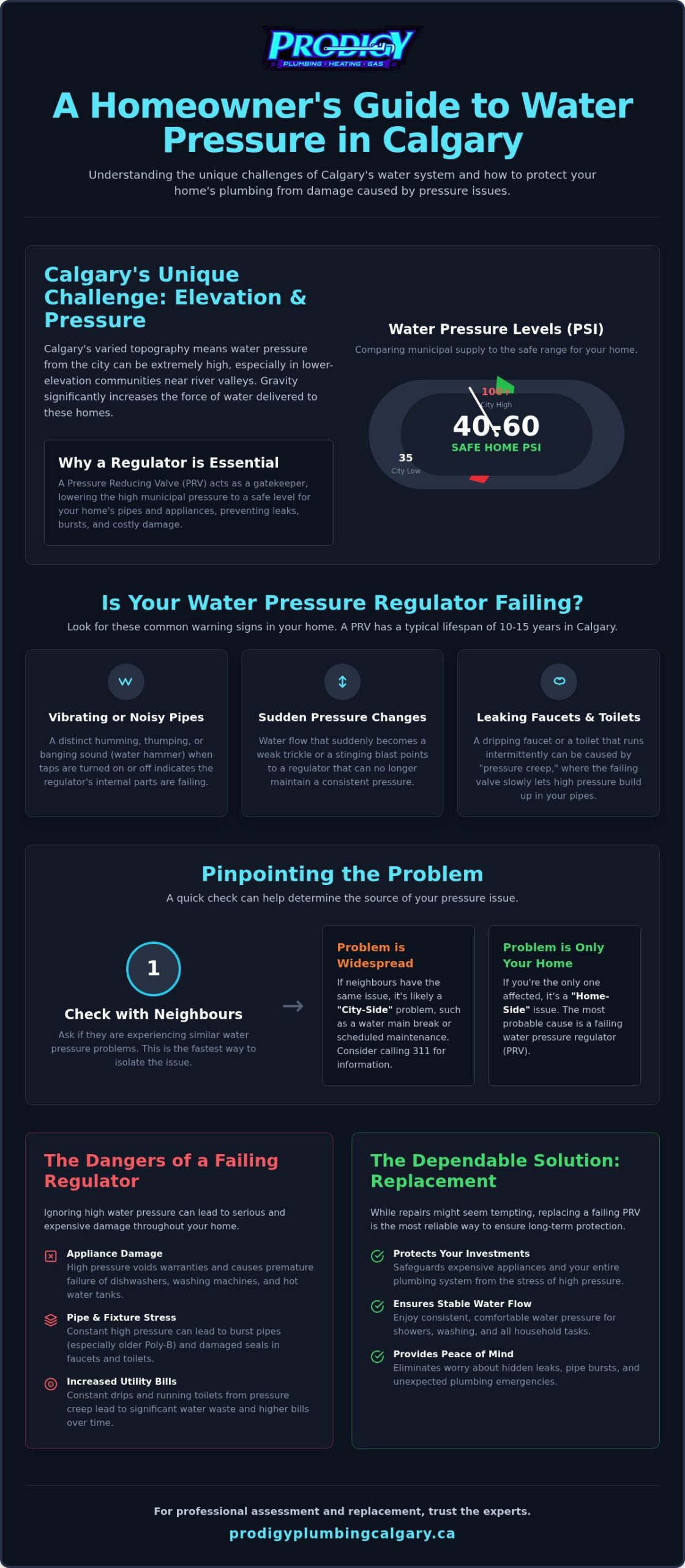
Residential properties in Calgary generally aim for a range of 40 to 60 PSI. While the city attempts to regulate municipal pressure between 35 and 100 PSI depending on the zone, the high end of that spectrum is far too intense for standard household pipes. If you experience water pressure regulator problems Calgary technicians often find that the incoming municipal pressure is simply overpowering an aged or failing valve. This can lead to inconsistent shower temperatures or even damaged seals in your faucets.
It’s helpful to distinguish where the fault lies before you worry about repairs. If your neighbours are also experiencing low flow, the issue is likely “city-side,” such as a water main break or scheduled maintenance. However, if the problem is specific to your house alone, it’s almost certainly a “home-side” mechanical failure. Identifying this early helps you decide whether to call 311 or a licensed plumber.
Why Calgary’s Elevation Matters for Your Plumbing
Calgary’s landscape is anything but flat. Homes located in lower-elevation areas, such as those near the Bow River valley, often receive significantly higher incoming pressure than homes on the hilltops. Because gravity pulls water down into these valleys, the municipal system must pump at higher intensities to reach every community. This makes a PRV mandatory in many newer Calgary neighbourhoods to prevent pipe bursts and protect your system. For a deeper look at how these components fit into your overall setup, you can consult our Complete Plumbing Guide for Calgary Homeowners.
The Role of the Pressure Reducing Valve (PRV)
Think of the PRV as a protective gatekeeper for your plumbing. A Pressure Regulator works by using a spring-loaded diaphragm to restrict the flow of water, ensuring it doesn’t exceed a safe threshold. Without this regulation, high-pressure surges can cause “water hammer” or even void the warranties on expensive appliances. Manufacturers of dishwashers, washing machines, and hot water tanks often specify maximum pressure limits. If your regulator fails and allows 80 or 90 PSI into your home, it can lead to premature leaks in these units that aren’t covered by the maker’s guarantee. Keeping this valve in good working order is the most effective way to realize long-term protection for your home.
Common Water Pressure Regulator Problems and Signs of Failure
A pressure reducing valve doesn’t last forever. In Calgary, the average lifespan of this component is typically 10 to 15 years. The mineral content in our local water supply eventually takes its toll on the internal mechanics. Common signs of water pressure regulator problems Calgary residents notice include sudden, unpredictable drops in flow or sharp spikes when a tap is first opened. You might also hear a distinct thumping or humming sound coming from the pipes. This noise often indicates that the internal diaphragm is vibrating or failing to seat properly, which signals that the unit is near the end of its functional life.
Another subtle sign of failure is “pressure creep.” This occurs when the valve allows a small amount of high-pressure water to bypass the seal even when it should be closed. Over time, this builds up excessive pressure within your home’s internal plumbing. You’ll notice it as a faucet that starts dripping for no reason or a toilet that begins “running” spontaneously. These aren’t just minor annoyances. They are symptoms of a regulator that can no longer hold back the municipal supply, leading to wasted water and higher utility bills.
The Impact of Calgary’s Hard Water on Your Regulator
Calgary’s water is known for its high mineral content. Calcium and magnesium deposits can accumulate inside the valve, eventually seizing the internal spring that manages the flow. When this spring sticks, the valve can no longer adjust to changes in incoming municipal pressure. This results in either a dangerously high surge or a frustratingly weak trickle. Scale buildup is a primary cause of premature regulator failure in Alberta because it prevents the mechanical parts from moving freely. If you’re concerned about your system’s performance, a quick inspection can help you decide if it’s time for a professional PRV replacement to restore your peace of mind.
High Pressure: The Silent Home Destroyer
While low pressure is annoying, high pressure is genuinely dangerous for your home’s infrastructure. It acts as a silent destroyer, putting constant stress on every joint, seal, and connection. This is particularly risky for homes with Poly-B piping, where excessive pressure can lead to catastrophic bursts and significant water damage. You can find more about why these valves are essential in these Water Pressure Regulator FAQs.
Watch for “spitting” faucets as a key warning sign. If you turn on a tap and it blasts air or water aggressively before settling down, your pressure is likely exceeding safe levels. This constant strain shortens the life of your dishwasher, washing machine, and water heater. Identifying these signs early prevents a minor mechanical failure from turning into a major emergency. A steady, regulated flow is the best way to protect your appliances and realize the full lifespan of your plumbing system.
Troubleshooting Low Water Pressure: A Step-by-Step Guide
Troubleshooting a drop in water pressure doesn’t have to be overwhelming. Following a methodical process helps you identify if you’re facing water pressure regulator problems Calgary homeowners typically encounter or if the issue lies elsewhere. Start with the simplest checks to rule out external factors before focusing on your home’s mechanical components.
First, determine if the problem is localized or systemic. If only your kitchen faucet feels weak but the bathroom shower is fine, the issue is likely a clogged aerator or a fixture-specific problem. If every tap in the house is affected, the problem is systemic. Next, check with your neighbours or call Calgary 311. Municipal water main repairs or hydrant flushing in your community can cause temporary pressure drops that have nothing to do with your equipment.
If the city confirms there are no local outages, inspect your main shut-off valve. This valve is usually located in the basement where the water line enters your home. Ensure it’s turned fully to the open position. Sometimes these valves are partially closed during routine maintenance and forgotten. Once you’ve confirmed the valve is open, perform a stress test. Open three or four fixtures at once, such as the kitchen tap, a bathroom sink, and a shower. If the flow at each fixture drops to a mere trickle, your regulator is likely failing to open wide enough to meet the demand.
To get a definitive answer, you can test the unit directly. Most hardware stores sell inexpensive pressure gauges that screw onto a standard threaded tap. To better understand what is a water pressure regulator and how it manages these loads, it helps to see the actual numbers your system is producing under pressure.
Testing Your Own Water Pressure
The easiest place to test your pressure is at an outdoor hose bib. Screw the gauge onto the tap, ensure no other water is running in the house, and turn the tap on fully. A healthy reading for most Calgary homes sits between 40 and 60 PSI. If the gauge reads below 30 PSI or above 80 PSI, your regulator needs attention. It’s a good idea to record these readings at different times of the day, such as early morning and late at night, to see if the municipal pressure fluctuates significantly in your neighbourhood.
When the Problem Isn’t the Regulator
Sometimes low pressure stems from other culprits. Clogged aerators or showerheads are common in Calgary due to mineral buildup. If you have a water softener, try putting it on “bypass” mode to see if the pressure returns. If it does, the softener’s internal resin bed might be restricted. Additionally, sediment buildup in an old hot water tank can restrict flow on the hot side of your system. If you notice a sudden pressure drop accompanied by visible pooling water or damp spots on your drywall, emergency plumbing in Calgary is the safest way to prevent further structural damage to your home.
Repairing vs. Replacing Your Water Pressure Regulator
When faced with water pressure regulator problems Calgary homeowners often ask if a simple repair is possible. While rebuild kits exist for some high-end industrial models, they are rarely a practical solution for standard residential units. Sourcing the exact internal components for an older valve is difficult, and the labour required to disassemble, clean, and rebuild a calcified regulator often exceeds the cost of a brand-new installation. Because a PRV is a sealed, precision-calibrated instrument, a full replacement is the only way to ensure 100 per cent reliability and protect your home from future surges.
Professionals favour replacement because it eliminates the guesswork of an aging spring or a thinning diaphragm. A new valve provides a clean slate, free from the mineral buildup discussed earlier. This approach is more economical in the long run, as it prevents a second service call when a repaired valve inevitably fails again. A new installation also allows us to upgrade your system to modern standards, ensuring the materials used are compatible with your existing pipework.
Can You Adjust a PRV Yourself?
Most regulators feature an adjustment bolt on the top of the bell-shaped housing. Turning this bolt clockwise increases the downstream pressure, while turning it counter-clockwise decreases it. However, you should exercise extreme caution. Over-tightening the bolt can bottom out the internal spring or rupture a weakened diaphragm, leading to an immediate loss of pressure control. If the internal components are already brittle from years of service, even a slight adjustment can cause the valve to fail entirely.
If you choose to attempt an adjustment, always use a screw-on pressure gauge to monitor the changes in real-time. Never adjust the valve blindly. Small turns can result in significant PSI changes, and pushing the system beyond 60 PSI puts unnecessary strain on your fixtures. If the pressure does not respond to the adjustment bolt, the internal mechanism is likely seized. Forcing a stuck bolt will only result in a leak at the adjustment point, necessitating an immediate replacement.
The Professional Replacement Process
A professional PRV swap is a methodical process. It begins with a full water shut-off and a system drain. Depending on the age of your plumbing, we may need to cut out the old unit and solder or press-fit new connections to ensure a leak-free seal. We also verify how the new regulator interacts with your hot water tank. When a new PRV is installed, it creates a “closed system,” meaning water can no longer expand back into the municipal main as it heats up. We ensure your thermal expansion tank is properly pressurized to handle this change, preventing your water heater’s relief valve from dripping.
We take a clean and economical approach to every installation, leaving your mechanical room exactly as we found it. Suspecting water pressure regulator problems Calgary homeowners often find that a professional PRV replacement is the most dependable way to stabilize their home’s plumbing and realize long-term peace of mind.
Professional PRV Solutions with Prodigy Mechanical
Homeowners across the city trust us because we understand the specific environmental challenges of our municipal water system. With over 15 years of industry experience, we’ve seen how water pressure regulator problems Calgary residents face can range from minor noise issues to catastrophic pipe failures. We don’t just swap parts; we ensure your entire plumbing system is balanced and protected for the long term. Our goal is to provide a service that lets you forget about your plumbing because it’s simply working as it should.
Why Choose a Local Calgary Specialist?
Choosing a local specialist means you get a technician who is intimately familiar with the high-pressure zones in our river valleys and the mineral-heavy water that affects our mechanical equipment. As an owner-operated business, we provide a level of personal accountability that larger, faceless companies often lack. We believe in transparency and integrity, which is why we offer straightforward per-job pricing rather than vague or inflated estimates. This honest approach is central to everything we do regarding plumbing and heating in Calgary. Our licensed technicians handle every installation with quiet thoroughness, ensuring that no step is skipped and no mess is left behind for you to clean up.
We take pride in our craft and understand that your home is your most significant investment. By focusing on outcome-oriented solutions, we ensure you gain the protection and smooth operation you need. We don’t rely on aggressive sales tactics or hype. Instead, we let our reputation for reliability and precision speak for itself. When you call us, you are speaking to professionals who have handled these specific Calgary issues many times before. Our methodical rhythm ensures the work is done right the first time, giving you one less thing to worry about.
Get Your Water Pressure Back to Normal Today
Ignoring a failing regulator is a risk that eventually leads to expensive emergency repairs. High pressure doesn’t just cause “spitting” taps or humming pipes; it actively degrades your home’s infrastructure every hour of the day. Resolving these water pressure regulator problems Calgary homeowners deal with is a manageable process that begins with a professional diagnostic visit. During this visit, we typically perform the following tasks:
- Verify the current incoming municipal pressure levels.
- Inspect the physical condition of your existing PRV and shut-off valves.
- Calibrate your system to the ideal 40 to 60 PSI range.
- Ensure your thermal expansion tank is functioning correctly to prevent water heater stress.
We are here to provide a calm, steady hand when your plumbing feels unpredictable. Contact Steve and the team at Prodigy Mechanical for a pressure check. We will assess your system, explain your options clearly, and get your water pressure back to a safe, reliable level so you can realize true peace of mind.
Protect Your Home with a Balanced Plumbing System
Calgary’s varied elevation and mineral-rich water create a demanding environment for your home’s plumbing. As we have explored, a functioning pressure reducing valve is your primary defence against the silent damage caused by municipal surges. Whether you are dealing with vibrating pipes or a sudden loss of flow, identifying these signs early prevents minor mechanical failures from turning into expensive floods or appliance replacements.
Addressing water pressure regulator problems Calgary residents frequently encounter requires a methodical approach and technical precision. At Prodigy Mechanical, we bring over 15 years of local experience to every job. Our licensed and insured technicians provide transparent, per-job pricing with no hidden fees, ensuring you know exactly what to expect before the work begins.
You don’t have to live with the stress of inconsistent pressure or the worry of hidden leaks. A properly calibrated system protects your fixtures and provides the quiet, reliable operation every homeowner deserves. Request a Professional Water Pressure Diagnostic from Prodigy Mechanical to secure your home’s infrastructure. We are ready to help you restore balance and realize true peace of mind in your household plumbing.
Frequently Asked Questions
How do I know if my water pressure regulator is failing?
You can identify a failing regulator by watching for sudden spikes in water flow or a consistent drop in pressure across all your fixtures. Other common signs include a high-pitched humming or thumping sound vibrating through your walls when you turn on a tap. You might also notice “pressure creep,” where faucets drip or toilets run spontaneously because the valve can no longer hold back the municipal supply effectively.
What is the average cost to replace a water pressure regulator in Calgary?
Industry data for the Calgary area shows that a professional regulator replacement typically ranges from $300 to $650, which includes the valve and labour. The cost of the pressure reducing valve itself generally falls between $50 and $250 depending on the model. At Prodigy Mechanical, we provide transparent per-job pricing based on your specific plumbing setup to ensure you receive an accurate and honest quote for the work required.
Can low water pressure in my house be a city-wide problem?
Yes, municipal issues such as water main breaks, hydrant flushing, or scheduled maintenance can cause temporary pressure drops in entire neighbourhoods. If you notice a sudden change, check with your neighbours or call Calgary 311 to see if there is an active alert in your area. If the city confirms the supply is normal but your home’s flow is still weak, the problem is likely a mechanical failure within your own system.
How long should a water pressure regulator last?
Most residential regulators in Calgary have a functional lifespan of 10 to 15 years. The longevity of the unit is often determined by the mineral content in our local water supply, which can cause internal scale buildup. Over time, these minerals seize the internal spring or degrade the rubber diaphragm, preventing the valve from adjusting to municipal pressure changes. Regular checks help you realize when a replacement is becoming necessary.
Will a new PRV fix my noisy, vibrating pipes?
A new pressure reducing valve often solves the “water hammer” or humming noises that occur when an old diaphragm begins to fail. When the internal components lose their elasticity, they can vibrate aggressively under the stress of high municipal pressure. Installing a properly calibrated regulator stabilizes the flow and removes the mechanical resonance that causes these disruptive sounds, protecting your pipe joints from unnecessary physical strain and wear.
Do I really need a pressure regulator if my pressure feels fine?
Yes, even if the flow feels comfortable, your incoming pressure might be high enough to damage your appliances silently. Many manufacturers void warranties on water heaters and dishwashers if they are exposed to pressure exceeding 80 PSI. A regulator is especially critical for Calgary homes with Poly-B piping, as it prevents the high-pressure surges that lead to catastrophic leaks. It’s a small investment that provides long-term protection for your entire home.
Can I adjust the water pressure myself using the regulator bolt?
You can adjust the pressure by turning the bolt on top of the valve, but doing so without a gauge is risky. Turning it too far can rupture a brittle diaphragm or cause your pipes to exceed safe limits. We recommend using a screw-on pressure gauge to monitor the PSI in real time. If the pressure doesn’t respond to your adjustments, the internal spring is likely seized and the entire unit requires professional replacement.
What happens if a water pressure regulator fails completely?
A complete failure can result in either a total loss of water flow or a dangerous surge of high-pressure municipal water into your home. High-pressure failures are the most concerning because they can lead to burst pipes, failed appliance seals, and significant flooding. Addressing water pressure regulator problems Calgary homeowners encounter early prevents these high-stakes emergencies. A proactive replacement ensures your plumbing stays within the safe 40 to 60 PSI range for dependable daily use.