
Imagine waking up on a Tuesday morning in January to find frost creeping across the inside of your windows. Your boiler has gone silent, and the house is quickly losing its battle against a -30°C Calgary cold snap. It’s a stressful situation that requires more than just a quick fix; it needs a specialist who understands the nuances of hydronic heating.
You likely already realize that a boiler is a sophisticated piece of equipment, vastly different from a standard forced air furnace. When you’re searching for boiler repair in Calgary, you want more than a technician who just swaps parts. You need someone who can balance the system and ensure long-term efficiency. It’s frustrating to deal with unexpected repair bills or contractors who don’t have the specific gas-fitting credentials required for this precise work.
This guide provides the clear, honest information you need to restore your home’s comfort. You’ll learn how to identify early warning signs of system failure, evaluate realistic repair costs, and select a licensed professional with the right experience. We’ll cover everything from simple maintenance checks to complex diagnostics, giving you the confidence that your heating system is in capable hands.
Key Takeaways
- Understand how Calgary’s extreme temperature fluctuations stress your hydronic system’s seals and mechanical components.
- Learn the professional diagnostic steps used for boiler repair in Calgary to distinguish between surface symptoms and deeper mechanical failures.
- Master the “50% Rule” to decide whether a repair or a high-efficiency replacement is the most cost-effective choice for your home.
- Discover how annual maintenance and hydronic flushing protect your circulator pumps from damaging sediment and sludge.
- Realize the critical safety and regulatory reasons why only a licensed gas fitter should handle boiler diagnostics and repairs in Alberta.
Understanding Boiler Failure in the Calgary Climate
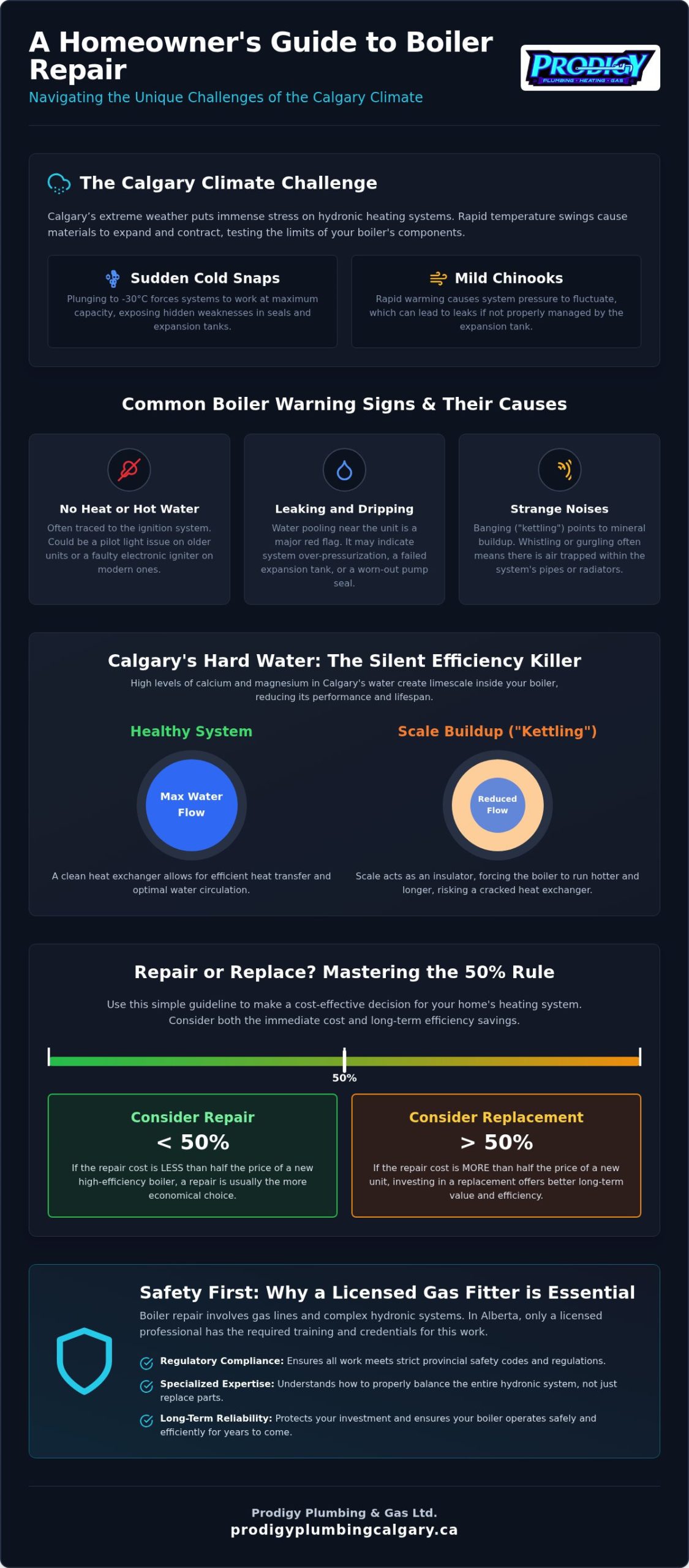
Calgary’s weather is notoriously unpredictable. One day it’s a mild chinook, and the next, it’s -30°C. These rapid shifts put immense pressure on your home’s heating infrastructure. When you require boiler repair calgary technicians usually find that the root cause is environmental stress. A boiler repair specifically involves the diagnosis and restoration of components within a hydronic, or water-based, heating system. Unlike a furnace that blows air, your boiler circulates hot water through a network of pipes to radiators or in-floor heating loops.
Maintaining this system is essential for more than just staying warm. In a Calgary winter, a failed boiler can quickly lead to frozen pipes. Without the constant movement of heated water, the plumbing in your exterior walls can burst, causing significant water damage. This makes a reliable, well-maintained boiler your primary line of defence against the elements.
The Impact of Calgary Water Hardness
Calgary’s water is notoriously hard, containing high levels of calcium and magnesium. Over time, these minerals settle inside your boiler’s heat exchanger, creating a thick layer of scale. This buildup leads to a phenomenon called “kettling,” where you’ll hear distinct banging or whistling noises as water gets trapped behind the mineral crust and turns to steam.
Beyond the noise, this scale acts as an insulator, forcing your boiler to run longer and hotter to achieve the same temperature. Because of our local water chemistry, boilers here often require more frequent flushing than systems in other parts of the country to maintain peak efficiency and prevent the heat exchanger from cracking due to overheating.
Seasonal Stress and System Pressure
The first -20°C night of the season is often when hidden weaknesses appear. As the system works harder to combat the cold, the water inside expands and contracts rapidly. This puts a heavy burden on your expansion tank, which is designed to manage these pressure changes. If the tank’s internal diaphragm fails, you’ll notice erratic pressure gauge readings or water leaking from the relief valve.
Managing these pressure fluctuations is a standard part of boiler repair calgary services. Ensuring your mechanical seals and expansion tanks are healthy prevents small leaks from becoming major failures during the peak of winter. A methodical approach to checking these components ensures the entire hydronic system remains balanced and reliable.
Common Boiler Issues and the Professional Diagnostic Process
A boiler that stops providing heat is rarely the result of a single, sudden failure. Most issues begin as small, quiet malfunctions that eventually lead to a system shutdown. When homeowners seek boiler repair calgary services, they’re often reacting to a lack of hot water or heat. However, the visible symptom is frequently just a mask for deeper mechanical or electrical problems. Identifying the root cause requires a methodical look at how the system’s components interact.
- No heat or hot water: This often traces back to the ignition system. On older units, a draft might blow out the pilot light, or a faulty thermocouple may fail to signal the gas valve. Modern high-efficiency systems use electronic igniters that can crack or become fouled with carbon.
- Leaking and dripping: Water pooling around the base of the unit is a clear warning. If water drips from the pressure relief valve, the system is likely over-pressurized or the expansion tank has failed. A leak from the pump housing, however, usually points to a worn-out pump seal.
- Strange noises: While we previously discussed kettling from mineral buildup, other sounds provide different clues. A high-pitched whistling often indicates air trapped in the heat exchanger, while gurgling usually means air is stuck in the distribution lines or radiators.
Electrical and Control Malfunctions
Modern boilers rely on sophisticated control boards to manage heating cycles. If your thermostat isn’t communicating correctly, the boiler might “short cycle,” turning on and off too rapidly. This wastes fuel and puts unnecessary wear on the heat exchanger. High-efficiency condensing boilers also display specific error codes. While these codes give a general direction, they often require a technician to realize whether the fault lies in the sensor itself or the component it’s monitoring. The circulator pump is another common failure point; if the motor seizes, the boiler will fire up but the heat will never reach your living space.
The Prodigy Diagnostic Approach
We believe in a thorough, non-rushed diagnostic process. Before touching a single tool, we perform a full visual inspection of the venting, piping, and electrical connections. We then test gas pressure and perform a combustion efficiency analysis to ensure the unit is operating safely. This is particularly important for preventing carbon monoxide leaks. We also verify the hydronic balance of the entire home. This ensures that every room receives even heat, rather than having some areas stay cold while others overheat. If your system is acting up, a professional diagnostic inspection can identify these hidden issues before they lead to an expensive mid-winter breakdown. Our goal is to provide a clear path to boiler repair calgary residents can trust for long-term reliability.
Repair vs. Replacement: Making the Right Call for Your Calgary Home
Deciding between an expensive boiler repair calgary homeowners often face or a full replacement is a significant financial choice. It’s about balancing immediate costs against long-term reliability. We use the “50% Rule” as a baseline. If the quote for a repair approaches half the value of a new system, it’s usually time to consider an upgrade. This is particularly relevant if your unit has surpassed the 15-year mark, as the probability of secondary component failure increases sharply after this point.
The shift from mid-efficiency to high-efficiency condensing boilers is another major factor. Older units often vent hot exhaust directly outside, wasting energy you’ve already paid for. Modern units capture that latent heat, which can noticeably reduce your monthly Calgary utility bills. If you find yourself booking a boiler repair calgary professional every winter for minor leaks or sensor issues, your system is likely signaling that its service life is ending. Constant small fixes often cost more over three years than the monthly financing of a new, efficient unit. Understanding what a boiler installation in Calgary involves — including 2026 efficiency regulations and licensed gas fitter requirements — can help you make a more informed decision when the time comes to replace your system.
Evaluating Component Availability
Sourcing specific parts for legacy boilers in Alberta is becoming a challenge. Many manufacturers have stopped producing components for older cast-iron models. This makes a simple valve swap affordable, but a cracked heat exchanger becomes a terminal issue. This same logic applies to hot water tank replacement Calgary residents often deal with. When the core of the machine fails, the cost of labour and parts rarely justifies the fix. We always check part availability before recommending a major repair on an aged system.
Long-Term ROI and Home Value
Upgrading to a modern wall-hung unit does more than just heat your home. It frees up floor space and adds significant value to your property. Calgary buyers in 2026 prioritize energy efficiency and mechanical reliability. A new boiler with a transferable warranty provides a level of protection that an old, patched-together unit simply can’t match. When you factor in the potential for local energy-efficiency incentives, the return on investment becomes even clearer. You’re not just buying a machine; you’re investing in five-plus years of predictable, quiet comfort without the anxiety of a mid-winter breakdown.
Maximizing Boiler Longevity: Actionable Maintenance Guidance
A well-maintained boiler is the difference between a quiet, efficient home and a series of expensive emergencies. While we often perform boiler repair calgary calls for systems that have already failed, many of these issues are preventable. An annual professional inspection allows us to catch small leaks at mechanical seals before they lead to water damage. Between visits, you should monitor your system’s pressure gauge monthly. Most residential boilers operate between 12 and 15 psi when the water is cold. A sudden drop often signals a leak, while a spike suggests an expansion tank issue that needs immediate attention.
Chemical treatment is another vital aspect of system longevity. We test the water inside your system to ensure the pH levels remain neutral. If the water becomes too acidic or alkaline, it begins to corrode the internal copper and steel components. Maintaining this balance prevents pinhole leaks and protects the integrity of your heat exchanger. This proactive care keeps the system running at the efficiency levels promised by the manufacturer.
The Importance of Hydronic Flushing
Over years of operation, hydronic heating systems naturally accumulate a black, metallic sludge known as magnetite. This debris is heavy and abrasive. It settles in the lowest points of your system and eventually destroys the bearings in your circulator pumps. Power flushing involves circulating high-velocity water and cleaning agents through your lines to restore original flow rates. This process removes the “sludge” that forces your boiler to work harder, ensuring your investment lasts its full intended lifespan without premature pump failure.
Preparing Your System for Winter
Before the first cold snap hits, take a few minutes to walk through your mechanical room. Ensure there is at least one metre of clear space around the boiler for proper combustion air. Check your exterior vent pipes for obstructions like bird nests or frost buildup. You should also bleed your radiators or baseboard heaters. Trapped air pockets prevent hot water from circulating, leaving you with cold spots in your home.
If you find yourself constantly adding water or bleeding air, it’s time to book a professional maintenance service to find the source of the vacuum leak. Taking these small steps now ensures your system is ready for the heavy demand of a Calgary winter. Our goal is to keep your home warm and your boiler repair calgary costs to a minimum through methodical, expert care.
Why Professional Boiler Services Require a Licensed Gas Fitter
Boilers are not simple machines. They operate at the intersection of high-pressure water, combustible gas, and complex electrical circuitry. Because of this complexity, attempting a DIY boiler repair calgary project is more than just difficult; it is dangerous. Gas leaks, improper combustion, and carbon monoxide poisoning are real risks when a system is handled by someone without the proper credentials. In Alberta, strict regulations govern who can work on gas-fired appliances. These laws exist to protect your family and your property from avoidable disasters like fires or silent gas leaks.
There is also a significant difference between a general plumber and a specialized hydronic technician. While a plumber might be excellent at clearing a drain or swapping a faucet, a boiler requires a deep understanding of fluid dynamics and gas-fitting. A specialized technician ensures that the gas valve is calibrated correctly and that the safety limits are functioning exactly as the manufacturer intended. This level of precision is what keeps a heating system running safely through a brutal winter.
Licensed Gas Fitting and Your Safety
When a licensed professional arrives for a repair, they do more than just fix the immediate part. They verify the integrity of the gas line and test the manifold pressure to ensure the burner is firing efficiently. Proper venting is also a critical safety factor, especially for modern high-efficiency boilers that produce acidic condensate. If the venting is blocked or improperly sloped, exhaust gases can back up into your living space. Knowing your plumbing and heating Calgary needs are handled by a certified gas fitter provides the peace of mind that your home is secure. It also ensures that your manufacturer’s warranty and home insurance remain valid, as both often require proof of professional service.
Choosing Prodigy Mechanical for Boiler Repairs
With over 15 years of experience serving Calgary neighbourhoods, we have seen every type of hydronic failure imaginable. Our approach is grounded in transparency and quiet thoroughness. We don’t believe in rushed diagnostics or inflated promises. Instead, we provide a clear, honest assessment of your system’s health and a detailed scope of work before we begin. We take pride in our craft and treat every boiler repair calgary call with the same level of care we would use in our own homes. Our goal is to restore your comfort with a methodical process that prioritizes long-term reliability over a quick, temporary fix. When you choose an owner-operated business, you get a level of accountability that larger, faceless companies simply cannot match.
Restoring Reliability to Your Home Heating
A quiet, efficient boiler is the backbone of home comfort during a Calgary winter. By addressing mineral buildup early and balancing your hydronic system, you can avoid the stress of a sudden mechanical failure. We’ve discussed how Calgary’s hard water and extreme temperature swings demand a proactive approach to maintenance. Whether you’re applying the 50% rule to decide on an upgrade or simply need to restore heat, the focus must stay on long-term mechanical health rather than a temporary patch.
Professional boiler repair calgary requires the technical precision of a licensed gas fitter who understands local safety regulations. Prodigy Mechanical is a Calgary owned and operated business with over 15 years of industry experience. We provide methodical diagnostics to ensure your system operates safely and efficiently for years to come. You deserve the peace of mind that comes from knowing your heating is in expert hands.
If your system is losing pressure or making unusual noises, don’t wait for the temperature to drop further. Request a Professional Boiler Diagnostic from Prodigy Mechanical today and keep your home warm and protected all season long.
Frequently Asked Questions
How much does a typical boiler repair cost in Calgary?
Repair costs depend on the specific component that failed and the labour time required for a proper diagnosis. A simple sensor replacement or a thermocouple fix is generally the most affordable type of service. More complex issues, such as replacing a circulator pump or a gas valve, involve higher part costs. We recommend a professional diagnostic to provide an accurate, transparent quote based on your system’s condition.
What are the signs that my boiler’s heat exchanger is failing?
A failing heat exchanger often presents as a visible water leak at the base of the unit or a distinct metallic banging noise. You might also notice a drop in heating efficiency or see soot buildup around the burner area. If the exchanger is cracked, it can cause the boiler to shut down entirely for safety. Any signs of failure require an immediate inspection by a licensed technician.
Why is my boiler making a loud banging or kettling noise?
Banging or kettling noises usually occur when Calgary’s hard water causes mineral scale to build up inside the heat exchanger. This scale traps water, which then turns into steam and creates a loud popping sound. It can also be caused by air trapped in the system or a failing circulator pump that isn’t moving water fast enough. A professional hydronic flush is often the best solution for this.
How often should I have my boiler serviced in Calgary?
Annual servicing is the industry standard for maintaining a reliable hydronic system. Scheduling an inspection every autumn ensures your boiler is prepared for the heavy demand of a Calgary winter. During this service, a technician will clean the burner and verify that all safety controls are functioning. Regular maintenance helps prevent the need for emergency boiler repair Calgary residents often face by catching small component wear early.
Can I repair my own boiler if it is a gas-fired unit?
In Alberta, work on gas-fired appliances must be performed by a licensed gas fitter to ensure safety and regulatory compliance. Attempting a DIY repair on a boiler involves significant risks, including carbon monoxide leaks, gas explosions, or fires. Additionally, unauthorized repairs can void your manufacturer’s warranty and may lead to issues with your insurance coverage. Always hire a qualified professional for boiler repair Calgary homeowners can trust.
How long does a boiler repair usually take to complete?
The duration of a repair depends on the complexity of the issue and the availability of replacement parts. A straightforward diagnostic and sensor swap often takes less than two hours. However, more intensive work like a full system flush or a pump replacement may take half a day. If your boiler requires a specialized part that isn’t stocked locally, the timeline may extend while we wait for the component.
What is the average lifespan of a boiler in a Calgary home?
Most residential boilers provide reliable service for 15 to 25 years depending on the model and maintenance history. Older cast-iron boilers are known for their longevity but offer lower energy efficiency. Modern high-efficiency condensing units are more complex and generally sit at the lower end of that range. Regular annual servicing and hydronic flushing are the most effective ways to ensure your system reaches its maximum lifespan.
Is it normal for my boiler pressure to rise when the heat is on?
A small increase in pressure is expected as the water in your system heats up and expands. Most systems should stay below 30 psi during operation. If you notice the pressure gauge climbing toward the red zone or if the relief valve starts dripping, your expansion tank might be failing or waterlogged. This component is designed to absorb that extra pressure, so an excessive rise is a sign of trouble.