

In Alberta, the line between a successful home renovation and a major safety hazard often comes down to a single professional certification. Many Calgary homeowners assume any skilled plumber can swap out a gas range or move a heater line. It’s a common mistake, but when you’re dealing with natural gas, “close enough” isn’t an option. You likely want the peace of mind that comes from knowing your family is protected from leaks and carbon monoxide. It is important to realize that hiring a qualified gas fitter isn’t just about convenience; it’s about ensuring your home meets the highest safety standards.
This guide explains exactly what a gas fitter does and why their expertise is a legal requirement in Calgary. We’ll show you why professional gas fitting is essential for your home’s safety and insurance standing. You’ll learn the critical differences between Class A and Class B licenses under the 2026 Alberta gas codes as you organize your next project. We also preview which appliances require professional installation and how to verify your technician’s credentials. By the end, you’ll have the confidence to hire an expert who prioritizes precision and follows every provincial regulation to the letter.
Key Takeaways
- Learn exactly what a gas fitter does and why they are the only professionals legally permitted to work on fuel-burning equipment in Alberta.
- Understand the distinction between Class A and Class B licences and why the 400,000 BTU threshold is important for residential services.
- Realize why a plumber and a gas fitter require different certifications, even though their work often happens in the same areas of your home.
- Identify which common appliances, from kitchen ranges to garage heaters, require professional installation to ensure safety and performance.
- Recognize how hiring a licensed expert protects your home insurance and prevents dangerous risks like gas leaks or carbon monoxide exposure.
Understanding the Role of a Licensed Gas Fitter in Alberta
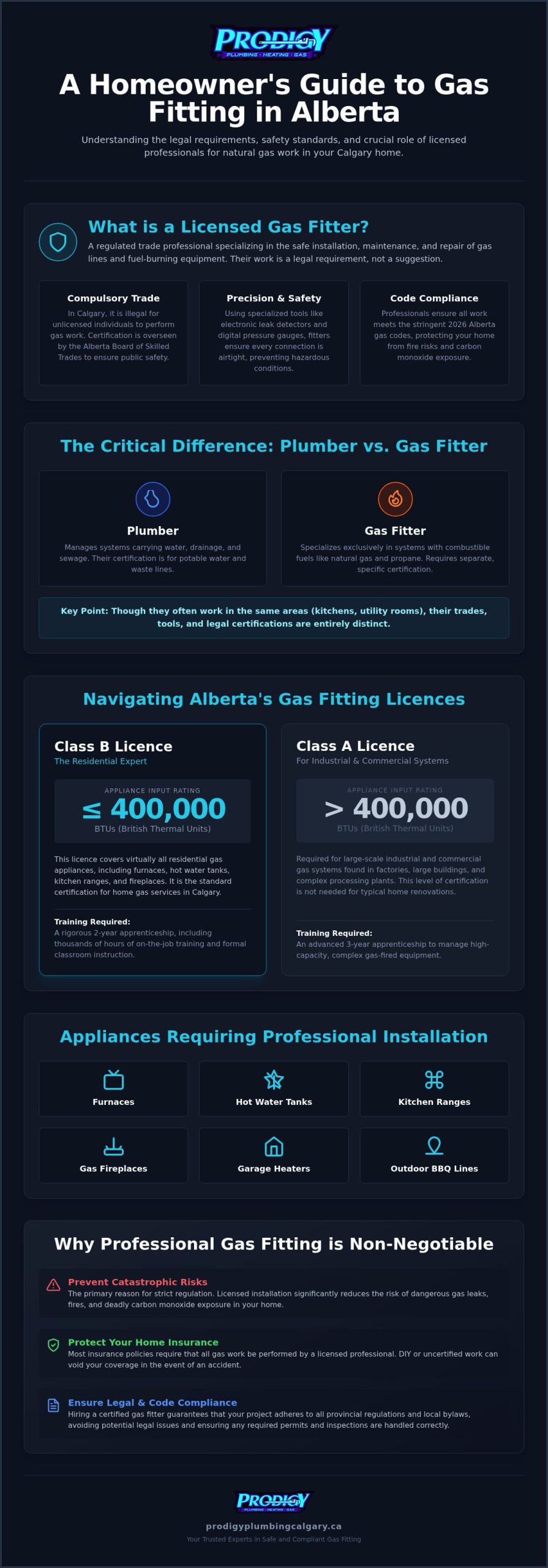
A gas fitter is a regulated trade professional who specializes in the safe installation, maintenance, and repair of gas lines and fuel-burning equipment. In Alberta, this isn’t just a job title; it’s a legal designation under the Skilled Trades and Apprenticeship Education Act. These technicians manage everything from the main gas line entering your home to the specific valves that feed your furnace or kitchen range. While they share some technical overlap with a Pipefitter, their focus remains strictly on systems carrying combustible fuels like natural gas and propane.
The work requires extreme precision and a specialized toolkit. We use high-grade digital pressure gauges, electronic leak detectors, and specialized pipe threading equipment to ensure every connection is airtight. Because natural gas is highly pressurized and flammable, there is no room for error. A single loose fitting or an improperly sized pipe can lead to hazardous conditions. This is why the province maintains such strict oversight of the trade, requiring meticulous documentation and inspections for most residential gas projects.
What Does a Gas Fitter Do Daily?
A typical day for a technician involves a mix of new installations and proactive maintenance. We don’t just hook up a pipe and walk away; we verify the safety of the entire system. Common tasks include:
- Pressure Testing: We use air or inert gas to test new lines for leaks before they ever carry fuel.
- Appliance Connections: This includes installing hot water tanks, kitchen ranges, and even outdoor barbecue lines.
- Component Replacement: We identify and replace defective gas valves, regulators, and pilot assemblies to keep systems running efficiently.
The Importance of Compulsory Certification
In Calgary, gas fitting is a compulsory trade. This means it is illegal for a general handyman or an unlicensed hobbyist to perform gas work on your property. The Alberta Board of Skilled Trades oversees these certifications to ensure every technician has completed thousands of hours of on-the-job training and rigorous formal schooling. This system exists for your protection. When a professional handles your installation, you know the work meets the updated 2026 Alberta gas codes. This significantly reduces the risk of carbon monoxide exposure or house fires. Choosing a licensed expert ensures that your home remains a safe, comfortable environment for your family while keeping your property compliant with local bylaws.
Class A vs. Class B: Navigating Gas Fitting Licenses in Calgary
Understanding the legal requirements for gas work in Calgary means looking at the specific class of licence a technician holds. Alberta divides gas fitting into two distinct categories: Class A and Class B. This division ensures that technicians are trained for the specific scale and complexity of the equipment they handle. For most homeowners, a Class B gas fitter is the standard professional for the job. The primary difference between these licences is the heating capacity of the appliances, measured in British Thermal Units (BTUs). A Licensed Gas Fitter in Alberta must strictly adhere to these limits to maintain their standing and ensure site safety.
The Class B Gas Fitter: Your Residential Expert
A Class B certification allows a technician to work on gas-fired equipment with an input up to and including 400,000 BTUs. To put this into perspective, a standard detached home in Calgary typically uses a furnace rated between 60,000 and 100,000 BTUs. Even if you have a high-efficiency hot water tank, a gas fireplace, and a professional-grade kitchen range, your total household demand will likely remain well under the 400,000 BTU threshold.
These professionals complete a two-year apprenticeship. Each year requires at least 1,560 hours of on-the-job training and eight weeks of technical classroom instruction. This training focuses heavily on residential safety, venting systems, and the precise calibration of household appliances. If you’re looking to upgrade your home’s comfort, our team at Prodigy Mechanical brings this specific residential expertise to every project.
When is a Class A Gas Fitter Required?
A Class A licence is necessary when the equipment exceeds the 400,000 BTU limit. This certification requires a three-year apprenticeship and covers high-output systems found in industrial settings or large commercial buildings. You might see a Class A professional working on industrial boilers in manufacturing plants or large-scale central heating plants for apartment complexes. They also handle commercial-grade grain dryers and heavy machinery.
While Class A fitters have a broader scope, the Class B professional is often more specialized in the nuances of residential codes and home appliance integration. Choosing the right gas fitter for your specific needs ensures the work is performed legally and safely according to the latest provincial standards. We prioritize this precision in every home we service, ensuring your systems are both efficient and fully compliant.
The Critical Difference Between a Plumber and a Gas Fitter
In the mechanical world, people often use the terms plumber and gas fitter interchangeably. This confusion is understandable because both trades work with pipes, valves, and fittings. However, the materials they move require entirely different handling. A plumber focuses on the complex network of water supply and drainage systems. A gas fitter manages the distribution of natural gas or propane. While a water leak causes property damage, a gas leak creates an explosive environment. Because of this, the safety protocols for gas work are far more stringent and require specialized testing methods that a standard plumber may not be trained to perform.
Overlapping Skills in Home Mechanical Systems
Many essential home services require a combination of both skill sets. A hot water tank replacement Calgary residents often request is a prime example. The technician must safely disconnect the water lines, but they also need to manage the gas supply and venting. Hydronic heating systems also bridge this gap. These systems use gas-fired boilers to heat water for radiant flooring. Having a technician who understands both sides of the system prevents communication errors and ensures the unit operates at peak efficiency. It simplifies the process for the homeowner and guarantees that every connection meets provincial standards.
Why One “Ticket” Does Not Cover All Work
In Alberta, holding a plumbing licence does not grant the legal right to work on gas lines. They are separate, compulsory trades. A professional must complete a dedicated apprenticeship for each designation. If a plumber without a gas ticket modifies your gas line, they are operating outside their legal scope of work. This creates a significant liability for you. Unlicensed gas work is a leading cause of insurance claim denials in Calgary. It also puts your family at risk of carbon monoxide poisoning if the venting or combustion air is not calculated correctly.
Verification is the best way to protect your home. Don’t be afraid to ask for a technician’s journeyman card before they start. A reliable professional takes pride in their credentials and will provide them without hesitation. This transparency is a hallmark of the quiet competence we value. By hiring a dual-licensed professional, you ensure that every part of your home’s mechanical system is handled with precision and care. You gain the peace of mind that your water lines are secure and your gas connections are airtight.
Common Residential Gas Services: From Ranges to Garage Heaters
When you hire a gas fitter, you’re bringing in a specialist who understands the specific demands of fuel-burning appliances. Many Calgary homeowners look to upgrade their lifestyle through kitchen renovations or outdoor enhancements. These projects require more than just a basic connection. They demand a deep understanding of fuel flow, venting, and pressure management. A professional ensures that your new equipment operates at peak efficiency while maintaining the highest safety standards. This level of care protects your property and gives you the confidence to enjoy your new appliances without worry.
Kitchen and Appliance Upgrades
Modern kitchen renovations often centre on the stove. Moving from an electric range to a gas model provides superior heat control, but it requires a new, dedicated gas line. A professional ensures the clearances between the cooktop and the cabinetry meet the strict 2026 Alberta gas codes. We also verify that your ventilation system can handle the increased combustion byproducts. This precision prevents the slow, odourless leaks that can develop behind finished cabinets when fittings aren’t perfectly seated. It also ensures your new investment doesn’t become a safety hazard. We take the time to test every joint and valve, ensuring the installation is airtight before we consider the job finished.
Outdoor Living and Seasonal Comfort
Calgary’s climate makes garage heaters a practical choice for many households. A radiant heater turns a cold, unused workspace into a functional area for year-round utility. This installation requires careful placement to ensure proper venting and a reliable gas supply. Similarly, running a permanent gas line for a barbecue or fire pit eliminates the daily hassle of heavy propane tanks. It also removes the trip hazards associated with loose hoses. We also perform safety inspections on gas fireplaces. These units often collect dust or develop pilot light issues during the summer months. A thorough check ensures they are ready to operate safely as soon as the temperature drops.
If you’re planning a home upgrade, contact our team at Prodigy Mechanical to ensure every connection is handled with care. We take pride in delivering quiet competence and reliable results for every Calgary household. Our experience allows us to spot potential issues before they become expensive repairs, keeping your home running smoothly through every season.
Why Professional Gas Fitting is Non-Negotiable for Your Home’s Safety
Safety in a gas-powered home isn’t just about following a checklist; it’s about respecting a system that carries high-stakes risks. While natural gas is a reliable and efficient fuel for Calgary homes, it requires a professional touch to remain contained. The hidden dangers of DIY work or hiring an unlicensed “handyman” are significant. Small errors in threading or a slightly loose connection can lead to slow, undetectable leaks. Even more concerning is the risk of carbon monoxide poisoning from improper venting. A qualified gas fitter uses specialized electronic sniffers and multi-stage pressure tests to ensure every joint is perfectly sealed before the fuel is ever turned on.
If you ever smell a “rotten egg” odour in your home, you must act immediately. Evacuate everyone from the building and do not touch any electrical switches or phones, as these can create a spark. Once you are safely outside, call the ATCO Gas emergency line or local emergency services. Dealing with gas requires a calm, methodical approach that prioritizes life safety over everything else. We bring this same level of caution to every installation, ensuring these emergency scenarios are prevented before they can start.
Insurance and Liability Risks
Beyond the physical dangers, unlicensed gas work creates a massive financial liability. In Alberta, most gas installations require a permit and a subsequent inspection. If you ever need to file a home insurance claim due to fire or water damage, the adjuster will look for these records. If they find that a gas line was modified without a permit or by someone other than a licensed gas fitter, they have the legal grounds to deny your claim entirely. This leaves you responsible for the full cost of repairs. Professional mechanical records also protect your property value. When it comes time to sell your Calgary home, having proof that your systems were installed by a licensed professional provides a significant advantage during the home inspection process.
The Peace of Mind of a 15-Year Veteran
At Prodigy Mechanical, we believe in the value of quiet competence. Steve brings over 15 years of industry experience to every job site, allowing him to spot subtle issues that less experienced technicians might overlook. This proactive approach often catches small leaks or venting obstructions before they escalate into emergency plumbing Calgary calls. We don’t rush through connections or skip testing steps to save time. Instead, we follow a methodical process that ensures your home is as safe as it was the day it was built. When you contact Steve for your gas services, you aren’t just getting a technician; you’re gaining the peace of mind that comes from a job done right the first time.
Securing Your Home with Expert Gas Services
Choosing a professional is about more than just checking a box for your renovation; it’s about protecting your home and family from preventable risks. You now understand that a licensed gas fitter brings specific training that a general handyman simply cannot match. From navigating the 2026 Alberta gas codes to ensuring your home insurance remains valid, it’s important to realize that the value of a journeyman ticket is clear. We prioritize quiet competence and precision in every connection we make.
With over 15 years of industry experience, our team provides the licensed and insured expertise you need for comprehensive plumbing, heating, and gas systems. We take pride in our methodical approach and our commitment to safety. This ensures your appliances run efficiently and your property remains fully protected. We are here to help you move forward with your home projects with total confidence and peace of mind.
Book a Licensed Calgary Gas Fitter Today
Frequently Asked Questions
Do I need a permit for gas fitting work in Calgary?
Yes, almost all gas work in Calgary requires a permit from the City of Calgary. This includes installing new lines, moving appliances, or replacing existing gas-fired equipment. Permits ensure that a safety codes officer inspects the work to verify it meets provincial standards. Skipping this step can lead to safety hazards and may result in the denial of future insurance claims related to your home’s mechanical systems.
Can a plumber also work on gas lines in Alberta?
A plumber can only work on gas lines if they also hold a valid gas fitter certification. These are two separate compulsory trades in Alberta. While many technicians are dual-licensed, you should never assume a plumber is authorized to handle fuel lines. Always ask to see their specific gas credentials before they begin any work on your natural gas or propane systems to ensure legal compliance.
What is the difference between a Class A and Class B gas fitter?
The primary difference is the heating capacity of the appliances they are permitted to service. A Class B gas fitter works on equipment with an input up to 400,000 BTUs, which covers nearly every residential furnace, water heater, and fireplace. Class A fitters are trained for high-output industrial systems that exceed this limit. For standard Calgary home services, a Class B professional provides the specialized expertise required for residential safety.
How do I know if my gas fitter is licensed?
You can verify a technician’s status by asking to see their journeyman certification card issued by the province. A reliable professional carries this identification and will provide it without hesitation. It is also wise to ensure the company they represent is licensed to operate in Calgary and carries active liability insurance. This transparency protects you from the risks associated with unauthorized or amateur mechanical work.
What are the signs of a gas leak in my house?
The most recognizable sign is a “rotten egg” smell caused by mercaptan, an additive used to make colourless gas detectable. You might also hear a faint hissing sound near pipes or notice dead patches of grass over buried lines. If you experience unexplained dizziness or nausea, evacuate your home immediately. Do not use phones or light switches. Call emergency services from a safe distance outside the building.
Is it legal to install my own gas barbecue line in Calgary?
No, it is not legal for a homeowner to install their own gas lines in Calgary. Alberta safety codes mandate that only a certified professional or a registered apprentice can perform this work. DIY gas fitting is dangerous and can lead to leaks or explosions. It also voids your home insurance policy. Hiring a professional ensures the line is pressure-tested and meets all current 2026 safety regulations.
Why is a gas fitter needed for a hot water tank installation?
A hot water tank requires more than just a water connection; it needs a precise gas supply and a properly sized venting system. The technician must calculate the correct combustion air to prevent carbon monoxide from entering your living space. They also verify that the gas pressure is calibrated correctly for the burner. This methodical approach ensures the unit operates efficiently and safely for its entire lifespan.
How often should I have my residential gas lines inspected?
Most professionals recommend a thorough inspection of your residential gas lines every one to two years. This is often completed during your annual furnace or boiler maintenance. Regular inspections allow a technician to identify corroded fittings, loose valves, or venting obstructions before they become hazards. It is a simple, cost-effective way to maintain the integrity of your home’s mechanical systems and ensure your family’s continued safety.