

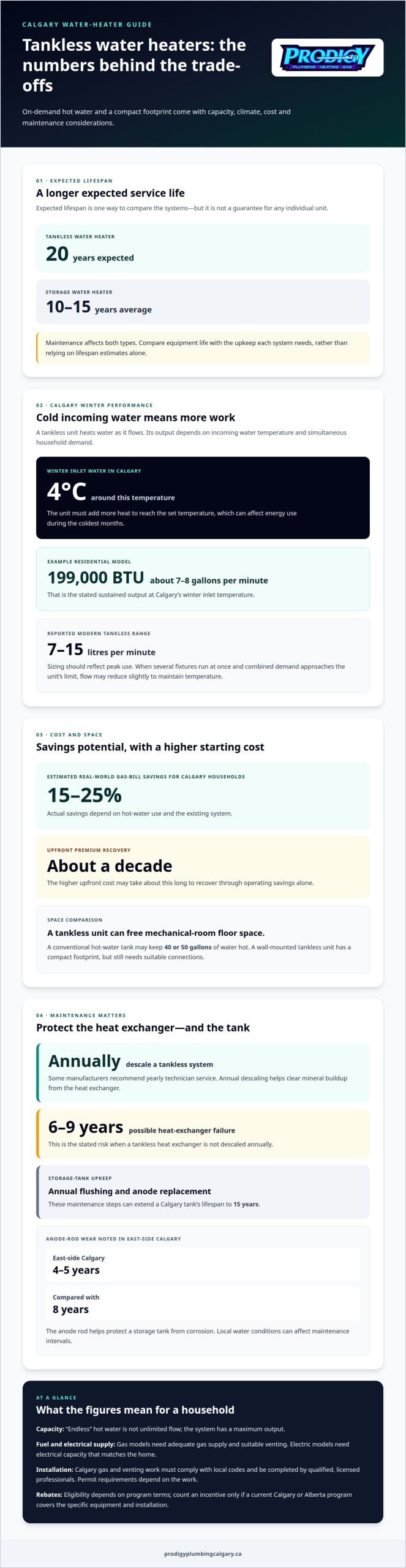
A tankless water heater can provide hot water on demand, free up mechanical-room space and last longer than a conventional tank. The benefits of a tankless water heater in Calgary come with trade-offs: the unit can cost more upfront, and cold winter water makes it work harder to reach your set temperature. A tankless model’s expected lifespan is 20 years, compared with 10 to 15 years for a storage water heater.
Those drawbacks matter, especially if your household uses several hot-water fixtures at once or you’re comparing the upfront cost with long-term operation. The right fit depends on how your home uses hot water and what matters most to you: a continuous supply, more space or a lower initial cost.
This article explains how tankless systems heat water on demand, what affects their performance in Calgary’s climate and how their lifespan compares with traditional models. It also covers the limitations to consider before deciding whether a tankless water heater suits your home.
Key Takeaways
- Tankless systems heat water when you need it, but their output has limits when several fixtures run at once.
- Compare the longer expected lifespan with the added upkeep: tankless models may last 20 years, while storage heaters average 10 to 15 years.
- In Calgary, cold winter water can make a tankless unit work harder, and the higher upfront cost is an important trade-off to weigh.
- Learn how household hot-water use and regular maintenance affect efficiency, performance and the long-term value of either system.
What Is The Downside Of A Tankless Water Heater?
The main trade-offs are a higher upfront investment, dependence on adequate fuel or electrical capacity, and performance that changes with demand. Calgary’s winter inlet water is around 4°C, so a tankless unit must add more heat before water reaches a tap. That extra work can affect energy use during the coldest months.
The benefits of a tankless water heater in Calgary can include lower standby energy use, since the system heats water when needed instead of continually reheating storage. Estimated real-world gas-bill savings for Calgary households are 15-25%, but the upfront premium may take about a decade to recover through operating savings alone. Actual savings depend on hot-water use and the existing system.
Space is another advantage. A conventional hot water tank may keep 40 or 50 gallons of water hot, while a wall-mounted tankless unit frees floor space in a mechanical room. For a Calgary apartment with limited storage, a wall-mounted indoor gas or electric model can be a space-saving option. Its compact footprint still requires suitable connections.
Gas and electric tankless units both heat water on demand. A gas model needs an adequate gas supply and suitable venting. An electric model avoids gas combustion, but its electrical requirements must match the home.
In Calgary, installation must comply with local gas and venting codes and be carried out by qualified, licensed professionals. Permit requirements depend on the work, including any changes to gas piping, venting or electrical connections.
Rebate eligibility depends on each program’s terms. Include an incentive in your calculations only if a current Calgary or Alberta program covers the specific equipment and installation.
Weigh the benefits of a tankless water heater in Calgary against the upfront cost, household demand, available space and installation requirements. These factors can help you decide whether its on-demand heating and compact design suit your home.
Lifespan compared with traditional water heaters
Tankless systems are generally expected to last longer than storage heaters, but maintenance affects both types. Compare expected service life and upkeep to plan an upgrade around your household’s actual use.
Lifespan Compared with Storage Heaters
A tankless water heater has an expected lifecycle of 20 years, while storage water heaters average 10 to 15 years. That difference can mean fewer replacement cycles over time, though it doesn’t guarantee every unit reaches its expected lifespan. For a household planning a renovation, the comparison helps balance equipment life against maintenance needs. An electric model still needs appropriate care; its power source alone doesn’t establish how long it will last.
Maintenance and Water Heater Lifespan
Maintenance protects the parts that heat water and help control temperature. Some tankless manufacturers recommend technician service once a year, and annual descaling matters because mineral buildup can damage the heat exchanger. Without annual descaling, a tankless heat exchanger can fail in 6-9 years. Traditional tanks also benefit from care: annual flushing and anode replacement can extend a Calgary tank’s lifespan to 15 years.
Local water conditions can affect maintenance intervals. In East-side Calgary, tank anode rods can wear out in 4-5 years, compared with 8 years. The anode rod helps protect a storage tank from corrosion, so its condition matters even if the water heater still heats water for a shower. For tankless systems, descaling helps clear mineral deposits from the heat exchanger. Regular service supports the expected lifespan; neglect can shorten it.
“Endless” hot water doesn’t mean the equipment lasts forever. A tankless unit has a maximum output, and its components can wear over time. Before choosing an upgrade, compare your existing tank’s age and service history with the maintenance a tankless system requires. Base your replacement plan on the unit’s condition, household use and upkeep, not lifespan estimates alone.
If a storage heater is nearing replacement, hot water tank replacement can help you plan the change with the system’s age and maintenance history in view.
How tankless water heaters heat water on demand
A tankless system heats water as it flows through the unit instead of storing hot water in a tank. Its output depends on the incoming water temperature and how much hot water your household uses at the same time.
When someone opens a hot-water tap, water passes through a heat exchanger. A gas burner or electric heating element warms the water as it flows through the unit. When the tap closes, heating stops. Unlike a tank water heater, the system doesn’t reheat stored water between uses, but it can deliver hot water only up to its capacity.
Calgary’s cold winter incoming water makes a tankless unit work harder to reach the set temperature. A typical residential 199,000-BTU model can sustain about 7-8 gallons per minute at Calgary’s winter inlet temperature. That gives households a practical way to assess winter performance against their expected use.
Capacity matters when several fixtures run at once, such as a shower and kitchen tap. If their combined demand approaches the unit’s limit, the heater may reduce flow slightly to maintain temperature. A continuous supply doesn’t mean unlimited flow: the system still has a maximum output.
Modern tankless water heaters are described as producing between 7 and 15 litres of hot water a minute. That range shows why sizing must reflect peak use, not just the number of people in a home. A household’s morning routine may create a different demand from evening laundry and dishwashing.
For households with higher demand, multiple tankless heaters can operate in parallel, or a separate unit can serve a high-demand appliance. These setups add capacity where it’s needed. The right arrangement depends on which fixtures run together and how much hot water they require.
To estimate your household’s typical demand, list the fixtures likely to run at the same time, such as two showers or a shower and dishwasher. Compare their combined use with the unit’s output at Calgary’s winter inlet temperature.
How tankless water heaters work
A storage heater keeps a reserve of hot water ready, while a tankless unit heats water as it passes through. Traditional water heaters commonly store 40-60 gallons, then use energy to maintain that supply between draws. Tankless operation changes where heating happens: inside a heat exchanger, only while water is moving through the unit.
In a gas-fired model, water flow triggers heating. The burner transfers heat to the exchanger, which warms the water before it travels to a fixture. Some gas models use intermittent ignition instead of an always-on pilot light. When those models aren’t operating, they use no natural gas for ignition.
Electric tankless models use heating elements instead of a gas burner. In both types, controls monitor the outlet temperature and adjust heating as water flows through the unit. This is especially relevant during Calgary winters, when colder incoming water needs more heat to reach the selected temperature.
When demand is high, a tankless system may not maintain its usual flow rate while keeping water near the selected temperature. If a shower and kitchen tap draw hot water together, the unit may reduce flow to keep the water near its set temperature. That’s the practical limit behind claims of “endless hot water”: supply can continue, but the system still has a maximum output.
Tankless systems can be more efficient partly because they avoid repeatedly reheating stored water. A storage tank loses heat between uses, so its burner or heating elements may cycle even when no tap is open. A tankless unit avoids this standby heating, although actual energy use depends on how much hot water you draw and how much energy is needed to heat it.
The key takeaway is that “water on demand” describes when water is heated, not unlimited capacity. A tankless system heats water during use and can reduce standby losses, but simultaneous showers or appliances still draw on a finite heating rate. Compare this operating pattern with your household’s daily routine before choosing a system.
Prodigy Mechanical: Fixture Swaps
Prodigy Mechanical handles fixture swaps, kitchen plumbing and bathroom plumbing for home updates. If you’re considering a different water-heating setup, these services can support related plumbing work, such as replacing a kitchen or bathroom fixture during a renovation.
Choosing a tankless water heater involves more than selecting a unit. Consider your household’s hot-water use, available space and existing plumbing. For fixture changes or kitchen and bathroom plumbing updates, Prodigy Mechanical can complete the related work. Commercial plumbing is also available for business properties.
For help with fixture swaps or plumbing updates in Calgary, contact Prodigy Mechanical.
Plan Your Next Step With Confidence
Before choosing a system, write a brief project plan. Note which hot-water tasks overlap at home, what matters most for comfort or space, and whether you’re already planning a kitchen or bathroom update. Focus on what you want to improve rather than choosing equipment by features alone. This makes the benefits of a tankless water heater in Calgary easier to assess for your home.
Use that plan to discuss your plumbing layout and intended use. A fixture change or renovation can affect the project scope, so consider the water-heating decision alongside the rest of the work. Prodigy Mechanical provides Fixture Swaps, Kitchen Plumbing and Bathroom Plumbing for related updates.
For help with plumbing work tied to your plans, contact Prodigy Mechanical today. A thoughtful plan gives you a clear starting point and makes the next decision easier.
Frequently Asked Questions
Does tankless mean unlimited hot water?
No. A tankless heater can keep producing hot water while a tap is open, but it has a maximum flow rate. If a shower and another fixture demand more hot water than the unit can heat at once, flow may drop to maintain temperature. For example, two showers and a running kitchen tap during a busy morning can exceed one unit’s capacity.
What are the main benefits of a tankless water heater compared with a storage tank heater?
Tankless models heat water as it’s used, avoid keeping stored water hot between draws and mount on a wall rather than taking up floor space. That can suit a compact Calgary mechanical room or apartment. A storage heater keeps hot water ready in its tank. The better option depends on whether space, on-demand heating or a stored reserve matters most in your home.
How much energy can a tankless water heater save in Calgary?
Estimated real-world gas-bill savings for Calgary households switching to tankless are 15-25%. The amount depends on how much hot water your household uses and how often a conventional tank reheats stored water. A household with low daily use may benefit differently from one with frequent showers, laundry and dishwashing. Cold winter inlet water also means the unit must add more heat.
What does a tankless water heater cost to buy and install in Calgary?
The cost depends on the unit, its capacity and the work needed to fit it to the home. Gas supply, venting, electrical connections and changes to existing plumbing can all affect the project scope. The price for a specific installation depends on the case and is provided after a quote request, based on the equipment and required site work.
What flow rate and size of tankless water heater suit a Calgary household?
Size the unit for the fixtures likely to run together, using its output at Calgary’s winter incoming-water temperature. A typical residential 199,000-BTU tankless heater can sustain about 7-8 gallons per minute at that winter inlet temperature. For example, count simultaneous showers and taps rather than choosing by household size alone. Homes with higher peak demand may need multiple units.
How long do tankless water heaters last, and what maintenance do they need?
A tankless heater has an expected lifecycle of 20 years, compared with an average of 10 to 15 years for a storage heater. Maintenance is central to reaching that service life: some manufacturers recommend technician servicing once a year, and descaling helps protect the heat exchanger from mineral buildup. Calgary homeowners should include that recurring upkeep in their ownership plans.