

A dull grey, non-magnetic pipe with a curved or bulging shape may be lead, and the water inlet is a common place to look. If you’re planning a lead pipe replacement program in Calgary, these clues can help you identify what to investigate, but appearance alone can’t confirm the material. A light scratch that reveals a silver surface is another clue.
It’s reasonable to want a clear answer before planning replacement. Lead exposure can harm children’s brain development and affect concentration and learning. Lead-contaminated water can also pose risks to an unborn baby.
This guide explains how to recognize possible lead pipes, what to know about health risks, and how copper, PVC, and PEX compare as replacement materials. You’ll also learn what can affect project costs and timelines, and where financial assistance may be available in Calgary. Use these details to understand your next steps and plan the work with confidence.
Key Takeaways
- Plan a replacement estimate around access, unit size, and whether shared work with neighbouring condo units can be coordinated.
- Find out how copper, PVC, and PEX differ so you can weigh material options against your home’s needs.
- Explore whether municipal or provincial financial assistance may help with replacement costs.
- Clarify whether the city or property owner is responsible for the section of water service line that needs work.
Repiping costs and project timelines
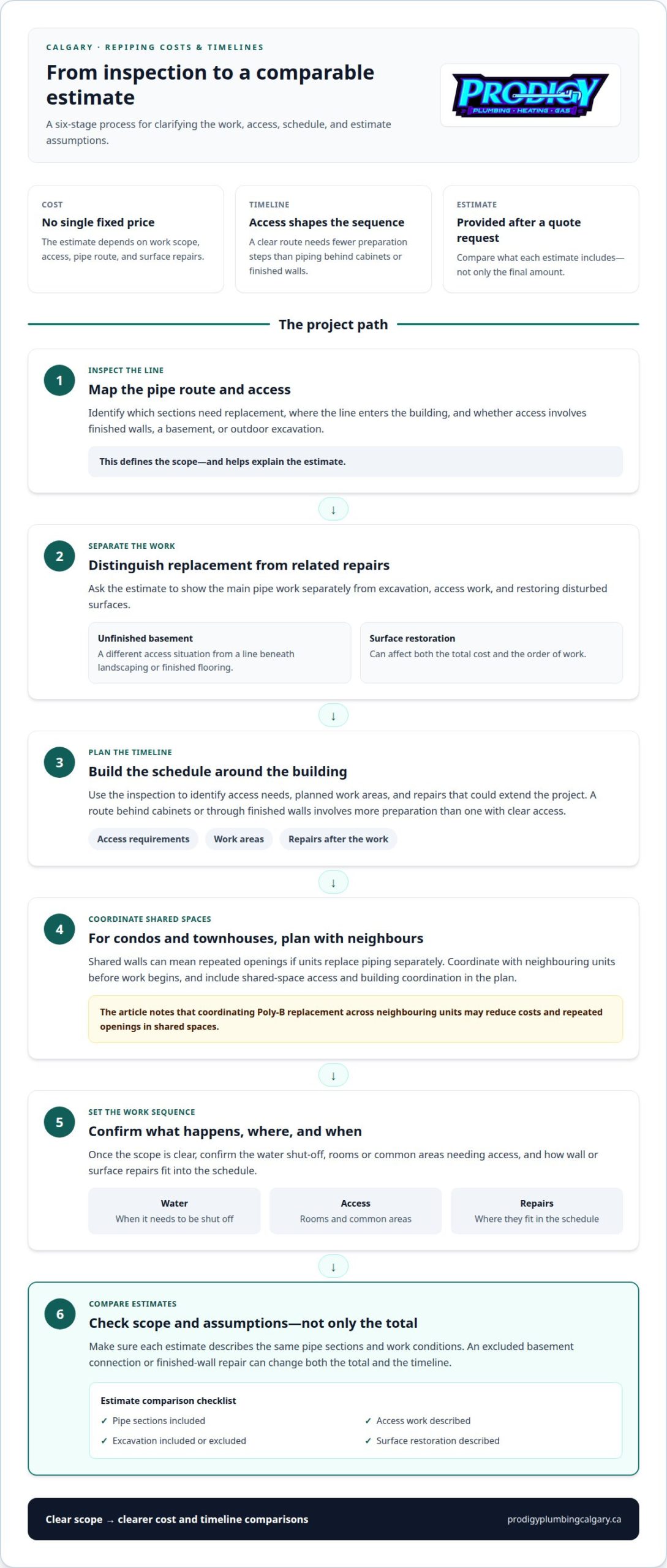
Lead service line replacement in Calgary has no single fixed price. The cost depends on the scope of work, access, pipe route, and surface repairs. An estimate is provided after you request a quote.
- Start with an inspection of the service line and its route. Identify which pipe sections need replacement, where the line enters the building, and whether access involves finished walls, a basement, or outdoor excavation. These details shape the scope and help explain the estimate.
- Ask for the estimate to separate the main work from related repairs. A line reached through an unfinished basement, for example, differs from one beneath landscaping or finished flooring. Excavation, access, and restoring disturbed surfaces can affect both the total cost and the work sequence.
- Plan the timeline around the building, not just the pipe. A straightforward route with clear access involves fewer preparation steps than a line running behind cabinets or through finished walls. The inspection should identify access needs, planned work areas, and repairs that could extend the project.
- For a Calgary condo or townhouse, coordinate with neighbouring units before work begins. Shared walls can mean repeated openings if each unit replaces piping separately. Coordinating Poly-B replacement across neighbouring units may reduce costs and repeated openings in shared spaces.
- Set the work sequence once the scope is clear. Confirm when the water needs to be shut off, which rooms or common areas need access, and how wall or surface repairs fit into the schedule. In a condo, include shared-space access and building coordination in the plan.
- Compare estimates by scope and assumptions, not just the final amount. Check whether each describes the same pipe sections, access work, excavation, and surface restoration. If one excludes a basement connection or finished-wall repairs, that can change both the total and the timeline.
Financial assistance for replacement
- Begin by identifying possible funding sources. Municipalities and the provincial government may offer financial assistance for lead pipe replacement. In Calgary, look for programs that specifically address lead service lines, rather than assuming general home repair support applies to plumbing.
- Check which part of the piping a program covers. Assistance may be limited to a service line, while other work could involve indoor plumbing or repairs to walls and landscaping. Read the program terms closely to distinguish eligible replacement work from related costs.
- Review eligibility before arranging the project. Program terms may set conditions based on property type, pipe ownership, or confirmed lead material. A homeowner and a condo unit owner, for example, may face different approval steps because shared building areas can be involved.
- Prepare clear project details for an application. Record the property address, suspected pipe location, inspection findings, and proposed scope of work. A written estimate can show which piping will be replaced and separate that work from surface restoration or other plumbing repairs.
- Confirm the order of application and installation. Some assistance programs may require an application or approval before work starts. Establish the sequence first to help prevent a completed replacement from falling outside program conditions.
- Ask how assistance is paid and what documentation is needed. Funding could be structured as a rebate, grant, or another form of support, depending on the program terms. Keep estimates, approvals, invoices, and proof of payment together for any required submission after installation.
- Include financial assistance in your project budget, but keep it separate from the plumbing estimate until eligibility and payment conditions are clear. This helps you see the full replacement scope, any costs not covered, and the amount you may need to pay yourself.
Lead pipe health risks
- Take possible lead in drinking water seriously, especially where children or an unborn baby may be exposed. Lead exposure can harm children’s brain development and affect concentration and learning. Lead-contaminated water can also pose risks to an unborn baby. These concerns make identifying the pipe material a practical first step.
- Arrange water-quality testing to find out whether lead is present at the tap. A dull grey service line or a suspected lead pipe in the basement is a reason to investigate, not proof of the water’s lead level. Regular testing can help track water quality and inform steps to reduce exposure.
- Use a certified activated carbon filter for drinking and cooking water if lead is a concern. Look for a filter that meets NSF Standard 53 for lead removal. These filters may attach directly to a faucet or be used in a filtration pitcher. Follow the filter maker’s replacement instructions so the cartridge is not used beyond its recommended life.
- Plan for possible residual lead after pipe replacement. Lead particles can remain in plumbing even after a lead pipe is replaced, so the new line alone may not resolve every concern. Include connected plumbing and water quality in the follow-up plan, and continue using suitable filtration while taking steps to reduce exposure.
- Keep drinking-water precautions consistent for everyone in the household. Use filtered cold tap water for drinking and cooking, including for ice, beverages, and infant formula. For example, fill a pitcher with filtered water rather than using an unfiltered tap for a child’s drink.
- Keep test results, filter changes, and replacement details together. If your household includes children or someone who is pregnant, share the water concern with a healthcare professional. These details provide relevant context while you arrange plumbing work and follow-up testing.
Who is responsible for replacing lead water service lines in Calgary: the city or the property owner?
- Start by separating the water service line into sections. Trace it from the municipal water main toward the building, then identify where it enters and connects to indoor plumbing. The City of Calgary and a property owner may have different responsibilities for different sections, so don’t assume one party covers the entire route.
- Locate the suspected lead section before deciding who should arrange replacement. A concern about the pipe outside the building, for example, differs from lead piping inside a basement. Record where the material begins and ends, and keep inspection findings with your property documents.
- Clarify responsibility for the specific section, not just the property address. A useful description includes the pipe’s location, where it connects, and whether it serves one home or shared spaces. In a condo, include the unit boundary and common areas.
- Before work begins, align the replacement plan with the party responsible for each affected section. Confirm how access, excavation, indoor piping, and surface restoration fit together. If the route crosses shared property, coordinate the work and approvals with the relevant building decision-makers.
- Keep the written scope and responsibility details with any application for financial assistance. They help distinguish municipal-side work from private-property work and show which costs relate to each section. If the project also involves indoor plumbing, plan the plumbing work for affected indoor piping as part of the same scope.
Prodigy Mechanical
Prodigy Mechanical can help with plumbing work inside your Calgary home as you plan next steps for a water service line. If the project affects kitchen or bathroom plumbing, the team can handle related work, including fixture swaps. Prodigy Mechanical also provides commercial plumbing for businesses and strata properties.
Keep service-line responsibility and any assistance application clear as you plan the work. Share details of the affected indoor plumbing, such as a kitchen connection or bathroom fixture, so the scope is understood before work begins. Prodigy Mechanical handles plumbing work within its service offerings, while municipal responsibility and funding eligibility are determined separately.
Contact Prodigy Mechanical to discuss plumbing work connected to your replacement plans.
Make your next step clear
Before moving ahead, bring your pipe-location notes, water test results, and proposed work scope together. A clear record keeps conversations about the service line, indoor plumbing, and possible assistance focused on the right part of the project. It also gives everyone involved a shared starting point for planning access and the work sequence.
As you consider Calgary’s lead pipe replacement program, keep the decisions organized: identify the section that needs attention, note who is responsible, and record any related plumbing work inside the property. Prodigy Mechanical can help with plumbing needs connected to your plans, including kitchen and bathroom work or fixture swaps.
Discuss your plumbing project with Prodigy Mechanical and take the next step with a clearer plan. A well-defined scope makes a complex job easier to manage, one decision at a time.
Frequently Asked Questions
Do you know how to recognize a lead pipe?
Possible clues include a dull grey colour, a curved or bulging shape, and a surface that turns silver when lightly scratched. A magnet won’t stick to lead, which can help distinguish it from magnetic pipe materials. Check the water inlet as well as visible piping. These clues suggest lead, but an inspection is needed to identify the material reliably.
What are the costs and steps to replace a pipe?
There’s no single cost for replacing a lead service line in Calgary. The price depends on the replacement scope, pipe route, access, excavation, and surface restoration. Start by identifying the affected section and arranging an inspection. Then request an estimate that describes the work and what it includes. Confirm responsibility for each section and coordinate access before setting the work sequence.
What are the criteria to be eligible?
Eligibility depends on the requirements of the financial assistance program. Before applying, gather the property address, available inspection findings, pipe location, and proposed replacement scope. Review whether the program covers the relevant property and pipe section, and which documents it requires. For a condo, include details about shared areas and building approval, since the line may cross common spaces.
Why replace lead pipes?
Replacing lead piping can help reduce a potential source of lead in drinking water. This matters for households with children, since lead exposure can harm brain development and affect concentration and learning. Lead-contaminated water can also pose risks to an unborn baby. Replacement is one part of reducing exposure; follow-up water testing and appropriate filtration can help guide household precautions.
Does Calgary have a lead pipe replacement program?
Municipal or provincial financial assistance for lead pipe replacement may be available, but this does not necessarily mean there is one citywide replacement program. For a Calgary property, identify the pipe section involved and review the requirements of any funding option before arranging work. Check whether support applies to the service line, indoor plumbing, or related restoration, as coverage can differ.
How can Calgary homeowners find out if their water service line contains lead?
Start with visible piping near the water service entry, often in the basement, and note its material and appearance. A non-magnetic test or light scratch can offer clues, but neither confirms the water’s lead level. Arrange an inspection to assess the line, and have the water tested to find out whether lead is present at the tap. Keep the findings together for planning.