

A furnace’s age is a guide, not the whole answer. A well-maintained gas furnace in a Calgary home typically lasts about 15 to 20 years, while a younger unit with an isolated problem may be a practical repair. Knowing when to replace versus repair a furnace in Calgary also depends on repeat breakdowns, the size of the repair and the furnace’s overall condition.
It’s reasonable to want a clear answer before committing to a major repair or replacement. This guide explains signs that may point toward either option, what affects furnace replacement estimates in Calgary, and how long a straightforward installation usually takes.
You’ll also learn how furnace age and performance factor into the decision, and why a major repair on an older unit deserves careful comparison with replacement. With these details, you can make a more informed choice for your home’s comfort and reliable heat.
Key Takeaways
- A well-maintained gas furnace in a Calgary home typically lasts about 15 to 20 years, but age alone doesn’t determine whether repair or replacement makes more sense.
- Use repeat breakdowns, overall condition and the size of a recommended repair to weigh your options.
- A straightforward furnace replacement is usually completed in one day; the work involved can affect the timeline.
- Compare replacement estimates by looking at what’s included and how the proposed system’s efficiency fits your home.
How Long Does a Furnace Replacement Take?
A straightforward furnace replacement is usually completed in one day. The repair-or-replacement decision often starts earlier, with the furnace’s age and condition. In a Calgary home, a well-maintained gas furnace typically lasts about 15 to 20 years. That range gives homeowners a useful reference, not a deadline for replacing every unit.
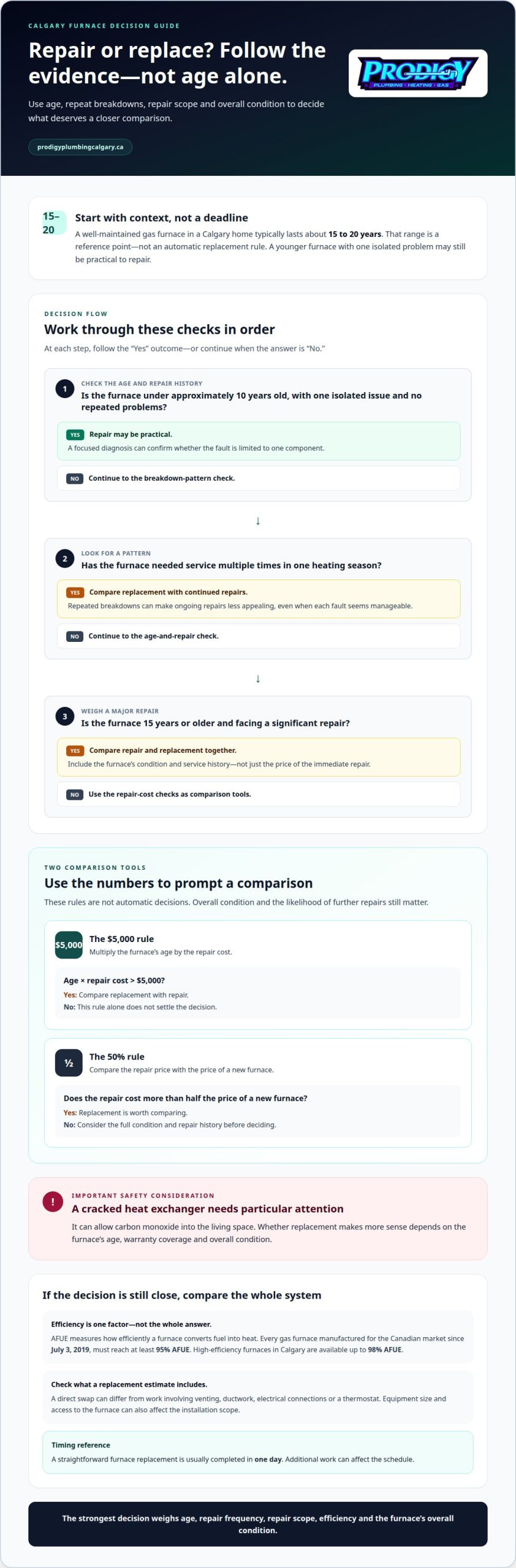
Age changes how a repair should be weighed. Repairing a furnace under approximately 10 years old may be practical when it hasn’t had repeated problems. As a unit approaches or passes 15 years, a significant repair is a reason to discuss replacement alongside repair. The same fault can lead to different choices depending on the furnace’s condition and service history.
Consider the pattern, not just the birthday. A 9-year-old furnace with one isolated issue may remain a sensible repair candidate. A 16-year-old unit that has needed service multiple times in one season deserves a closer replacement comparison. Repeated breakdowns can make continued repairs less appealing, even if each individual problem seems manageable.
Efficiency can also inform the decision. AFUE, or annual fuel utilization efficiency, describes how efficiently a furnace converts fuel into heat. According to Natural Resources Canada, every gas furnace manufactured for the Canadian market since July 3, 2019, must reach at least 95% AFUE. An older furnace’s rating and current condition help frame the potential efficiency difference, but age alone doesn’t establish future energy savings.
Replacement timing depends on the work required, not just the new furnace. The installer needs to assess the existing setup and determine what the installation involves. A straightforward swap usually takes one day, while additional work can affect the schedule. Treat a furnace’s age as a reason to compare options, not an automatic replacement rule.
For Calgary homeowners weighing when to replace versus repair a furnace, combine its age with repair frequency, overall condition and efficiency. A working furnace nearing 15 years can be assessed before winter, giving more time to consider the options. A clear comparison helps distinguish a repairable problem from a unit nearing the end of its reliable service life.
Installed furnace replacement costs in Calgary
For Calgary, homeowners can consider high-efficiency furnaces rated up to 98% AFUE. Single-stage, two-stage and modulating models are options; sizing and installation needs determine the right fit.
Installation complexity and cost factors
Installation complexity means the additional work needed to fit and connect a replacement furnace. A direct swap differs from an installation that requires changes to venting, ductwork, electrical connections or the thermostat. Equipment size and access to the furnace can also affect the work. A useful estimate identifies the equipment and explains any changes needed for safe, suitable operation, making it easier to compare installation scopes.
Efficiency ratings and furnace types
AFUE measures how efficiently a furnace converts fuel into heat. A higher rating indicates greater fuel efficiency, with modern high-efficiency models reaching up to 98% AFUE. Single-stage, two-stage and modulating furnaces offer different operating approaches. Calgary homeowners can weigh efficiency against the home’s heating needs and the installation requirements. A suitable choice depends on the furnace’s capacity and the system it must serve, not the rating alone.
To compare repair costs with replacement, consider the furnace’s age, condition and the repair scope. The $5,000 rule suggests comparing replacement when age multiplied by repair cost exceeds $5,000. The 50% rule suggests replacement when a repair costs more than half the price of a new furnace. These are comparison tools, not automatic decisions. The overall condition and likelihood of further repairs still matter.
Repair costs vary by fault. A thermostat issue or dirty filter differs from a failed control board, blower motor or heat exchanger. A technician’s diagnosis helps identify the part and labour involved. For a furnace at least 15 years old facing a significant repair, compare repair and replacement options together.
Annual maintenance can catch issues before they grow and support reliable operation. An inspection can assess components, airflow and thermostat response. Regular attention may help limit breakdowns, but it cannot prevent every fault. A professional installation assessment can clarify which work factors apply to a home.
Signs of declining furnace performance
A single fault, such as an ignitor problem, may call for repair. Repeated service calls in one heating season can point toward replacement. A technician can consider the fault, the furnace’s condition and its repair history to distinguish a manageable issue from declining reliability.
Signs a furnace may need replacement
Replacement becomes worth discussing when breakdowns recur or a major component fails in an older furnace. Needing service multiple times in one season is a warning sign, especially when heating interruptions keep returning. If a furnace is 15 years or older and needs a significant repair, compare replacement with repair rather than considering the repair alone.
A cracked heat exchanger needs particular attention because it can allow carbon monoxide into the living space. Whether replacement makes more sense depends on factors such as the furnace’s age, warranty coverage and overall condition. An assessment of these factors can help determine whether a costly repair is reasonable or whether continued operation raises concerns.
Signs a furnace may need repair
Thermostat issues, ignitor problems and dirty filters are examples of faults that may be fixable without replacing the furnace. These symptoms alone don’t mean the furnace has reached the end of its lifespan. A focused diagnosis can show whether the problem is limited to one component or part of a broader pattern of failures.
For example, an ignitor fault in a furnace without a history of recurring problems may be a repair candidate. Repeated service calls during the same heating season, on the other hand, suggest the system may be becoming unreliable. The furnace’s age and the scale of the recommended work help distinguish these situations.
Safety signs need immediate attention. If a carbon monoxide alarm sounds or someone develops flu-like symptoms, get everyone outside and call 911. A suspected cracked heat exchanger should also be treated seriously, since it can let carbon monoxide enter the home. Don’t confuse a safety concern with a routine repair decision.
Furnace replacement prices in Calgary
Replacement pricing depends on the furnace and the work required to install it. Because a furnace is a major home expense, compare the proposed scope, not just the bottom-line figure. A clear estimate shows what the price covers and whether the system suits your home.
Furnace replacement estimates in Calgary can vary with equipment type, heating capacity and installation complexity. Venting, ductwork, electrical changes, access to the furnace and removal of the existing unit can all affect the work. The estimate should explain what’s included and identify any changes required for the installation.
Compare estimates using the same details: furnace type, capacity, efficiency rating, removal, installation labour and stated modifications. For example, an estimate that includes venting changes isn’t directly comparable to one covering only a basic swap. Differences in scope can explain why estimates vary, even for the same home.
To decide between repair and replacement, weigh the repair against the furnace’s condition and likely future needs. A lower immediate repair expense may not be the only consideration if faults keep recurring or a major component needs replacement. Replacement is a larger project, so the equipment and installation work should suit the home without exceeding its needs.
Ask for an estimate that separates equipment from installation work and describes the factors affecting the total. The price depends on the case and is provided after a quote request; the main cost factors include furnace type, capacity, venting, ductwork, access and required modifications. This gives homeowners a practical basis for comparing estimates without treating different scopes as equivalent.
Comfort and dependable heating matter alongside the initial expense. A correctly selected furnace must suit the home’s heating requirements, while installation details affect how the system operates. Review the equipment and work included before making a decision. To discuss a replacement estimate, request furnace pricing.
Prodigy Mechanical: Drain Cleaning & Repair
Prodigy Mechanical provides Drain Cleaning & Repair for plumbing issues around the home. Furnace repair or replacement concerns your heating system, while a slow or blocked drain needs plumbing service. Keeping these needs distinct helps you arrange the right work for each problem.
Recurring drainage trouble may need professional attention, while a leaking kitchen or bathroom fixture may call for plumbing repair or a fixture swap. Prodigy Mechanical also handles Kitchen Plumbing and Bathroom Plumbing to address these household plumbing needs.
If you have a drain or plumbing issue to discuss, contact Prodigy Mechanical.
Choose a Clear Next Step for Your Furnace
Deciding when to replace vs repair a furnace in Calgary is easier when you start with your home’s priorities, rather than feeling pressured to choose quickly. Consider what matters most to your household: dependable heat, fewer disruptions or planning a replacement around your needs.
Give a heating professional a clear account of the symptoms, when they occur, how often the furnace has needed service and any previous repairs. You can also explain what you value in day-to-day comfort. This keeps the discussion focused on your system and the options that suit your home. Start with the concern prompting your decision; you don’t need to settle every detail beforehand.
For help with furnace-related heating needs, discuss your options with Prodigy Mechanical. A focused conversation can help you choose a practical next step and move forward with confidence.
Frequently Asked Questions
How Long Do Furnaces Last?
A furnace’s lifespan varies with its type, maintenance and operating condition. General estimates range from 15 to 30 years, while a well-maintained gas furnace in a Calgary home typically lasts about 15 to 20 years. For a homeowner, that range is a planning guide rather than a guaranteed service life. Frequent faults or declining operation can make a furnace worth assessing sooner.
Is It Safe to Keep Running My Furnace While I Decide?
If you’re concerned about a possible hazard, leave the home and seek help from a safe location. Stay outside until responders say it’s safe to return. If someone develops flu-like symptoms, get everyone outside and call 911. Keep carbon monoxide detectors installed and working in appropriate areas of your home.
Is It Worth Repairing a 20-Year-Old Furnace?
It can be, but the furnace’s condition and the repair matter more than age alone. For a 20-year-old unit, weigh the fault’s severity, warranty coverage, repair history and whether other components show signs of wear. A minor isolated issue may have a different outlook from a major failure alongside recurring breakdowns. Compare the repair recommendation with the system’s remaining condition.
Will a New Furnace Lower My Gas Bill?
A more efficient furnace can use less gas to provide the same heat. For example, a new 95% furnace uses roughly 16% less gas than an older 80% furnace for the same heat output. Your bill also reflects how much heat your home needs and how the system is used, so lower gas use doesn’t translate into identical savings for every household.
How long do furnaces typically last in Calgary?
A well-maintained gas furnace in a Calgary home typically lasts about 15 to 20 years. The actual service life depends on maintenance, operating condition and the pattern of faults. A furnace can need attention before reaching that range, while age alone doesn’t mean it has failed. The unit’s performance and repair history provide useful context for planning.
What is the average cost to repair a furnace in Calgary?
Furnace repair costs depend on the fault and the work required. A thermostat or ignitor issue differs from replacing a control board, blower motor or heat exchanger. Diagnosis, parts and labour all affect the estimate. Ask for the fault and proposed work to be clearly identified, then weigh the repair against the furnace’s condition and history.