

Could a quick plumbing fix turn a small drip into water damage behind a cabinet or ceiling? It can, especially if a fitting is overtightened, the wrong tool is used, or the water supply is still on. Knowing the DIY plumbing mistakes to avoid can help protect your Calgary home and show you when a repair is beyond the limits of a safe DIY job.
It’s reasonable to want to handle a minor repair yourself, but online instructions can leave out important details, and not every plumbing task is as simple as it looks. This guide covers how to prepare for basic work, avoid common errors, and respond if a repair starts leaking. It also explains when to stop. Some plumbing changes require permits, and certain repairs call for a licensed professional.
Faucets, drains, toilets, and exposed pipes all have their own risks. The safest DIY decision is knowing where the repair boundary lies. If a leak persists or you’re unsure what’s behind a fixture, Prodigy Mechanical’s licensed technicians provide plumbing repair and emergency response in Calgary.
Key Takeaways
- Before starting, identify the fixture, locate the water shut-off, gather the right tools, and protect the work area.
- More force won’t fix a mismatched fitting or incorrect assembly. Treat a connection that resists or won’t align as a reason to pause.
- Routine observation and care carry different risks from opening, altering, or replacing plumbing. Consider what could happen if the work fails.
- Know how to stop the water before you begin, and keep the work area clear in case a leak develops.
- Stop work if water is uncontrolled, a valve fails, a pipe is damaged, or you find an unfamiliar connection.
DIY plumbing mistakes to avoid before you start a repair
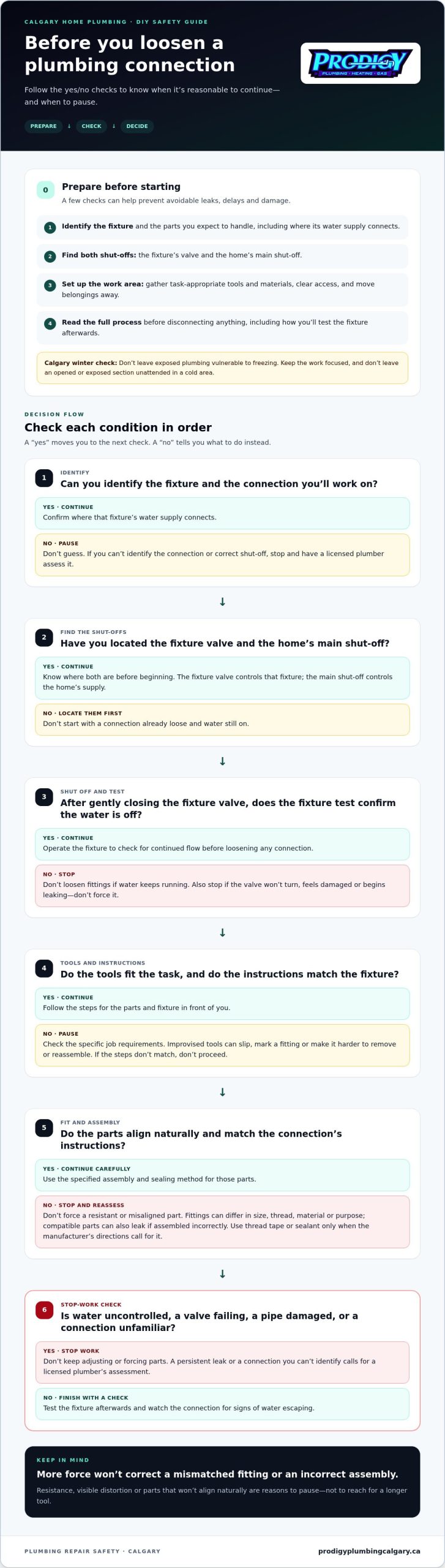
Preparation helps prevent avoidable leaks, delays, and damage. Before you start, identify the fixture and the parts you expect to handle. Find the correct water shut-off, gather tools suited to the task, and clear and protect the work area. A few minutes of planning can prevent discovering a missing tool or an active water supply after a connection is already loose.
- Identify the fixture: Know which tap, toilet, or other fixture you’re working on, and where its water supply connects.
- Locate the shut-off: Find the fixture’s shut-off valve and the home’s main shut-off before you begin.
- Prepare the work area: Gather appropriate tools and materials, clear access, and move belongings away from the work area.
- Understand the steps: Read the full process before disconnecting anything, including how you’ll test the fixture afterwards.
Turning a valve doesn’t prove that the water has stopped. After carefully closing the fixture’s supply valve, operate the fixture to test it before loosening a connection. Watch for continued flow rather than assuming a brief pause means the line is empty. If water keeps running, don’t proceed. A fixture valve controls water to that fixture; the home’s main shut-off controls the supply to the home. Know where both are so you’re not searching for the main valve during a leak.
Forgetting to shut off or test the water supply
Locate the appropriate valve before starting and turn it off gently. If it won’t turn, feels damaged, or begins leaking, stop rather than forcing it. A valve that fails under pressure can make a small repair harder to manage. Don’t loosen fittings until you’ve confirmed that the fixture’s water supply is off.
Starting without the right tools or a clear plan
There isn’t one tool list for every plumbing task. Check what the specific job requires and use tools that fit the parts you’ll handle. Improvised tools can slip, mark a fitting, or make a connection harder to remove or reassemble. Read the instructions first, and pause if the steps don’t match the fixture in front of you.
Before opening a plumbing connection, know what you’re working on, how to stop its water supply, which tools fit the task, and what you’ll do if water keeps flowing.
Plumbing systems include components that supply and drain water, so a fixture repair can involve more than the visible part. This overview of plumbing systems can help explain common terms, but instructions for one setup may not apply to another. If you can’t identify the connection or the correct shut-off, don’t guess.
Calgary’s winter conditions are another reason to plan carefully. Avoid leaving exposed plumbing vulnerable to freezing while a repair is underway. Keep the work focused, and don’t leave an opened or exposed section unattended in a cold area. These checks make DIY plumbing mistakes to avoid easier to catch before work begins, rather than after water has reached the floor.
Avoid leaks by handling plumbing connections and parts correctly
A connection that feels tight isn’t necessarily sealed properly. Plumbing fittings are designed to join in specific ways, and a mismatch or assembly error can leave a path for water to escape. Applying more force might seem to help, but it can damage the parts that need to hold the connection securely.
Keep these two issues separate as you assess a repair:
- Mismatched fittings: Parts can look similar but differ in size, thread, material, or purpose. Choosing by appearance alone, or joining incompatible materials, can result in a poor fit or a connection that fails.
- Incorrect assembly: Even compatible parts can leak if assembled in the wrong order, orientation, or manner for that connection. Follow instructions for the specific fixture and parts, not steps from a different repair.
If a part doesn’t sit or align as expected, don’t force it. Recheck what the connection is designed to join. If you can’t identify it with confidence, pause and have a licensed plumber assess it.
Overtightening fittings or forcing a stuck valve
Notice resistance, visible distortion, or a fitting that won’t align naturally. These signs can mean parts are cross-threaded, incompatible, or out of position. Forcing them can damage threads, seals, valves, or connected pipework, turning a small repair into a larger one. Stop if a valve or connection won’t move normally.
Overtightening can deform a fitting, damage threads or seals, and strain a valve or connected pipework. The result may be a leak, not a better seal. There’s no universal tightening rule for every plumbing connection. If parts seem to need extra force, stop and reassess instead of reaching for a longer tool.
Using the wrong fitting or sealing method
Thread tape and sealants aren’t suitable for every connection. Some joints rely on other sealing parts, and adding tape where it isn’t specified can interfere with how the fitting is meant to seal. Use a sealing method only when the manufacturer’s directions call for it, and follow those directions for the connection in front of you.
Don’t assume tape or sealant will correct a mismatch or an incorrectly assembled joint. If a connection still weeps after assembly, it may need to be taken apart and identified, not covered with more material. If you can’t tell whether a joint is threaded, what type of fitting it uses, or which sealing method applies, avoid further adjustments. A licensed plumber can identify the connection and address the leak without guesswork.
These are common DIY plumbing mistakes to avoid: relying on force, choosing parts by appearance, and using thread tape as a universal fix. If a connection is unclear or a repair has started leaking, Prodigy Mechanical’s Calgary plumbing repair service can help.
Which DIY plumbing jobs are safer, and which should you leave alone?
To judge a plumbing task, consider what you’ll need to open, change, or replace, and what could happen if the work fails. Basic observation and care usually carry less risk than disturbing a pressurized connection, working near concealed pipes, or changing a fixture’s location. This comparison is a guide, not permission to take on unfamiliar or regulated work.
| Routine observation or care | Opening, altering, or replacing plumbing |
|---|---|
| Looking for visible drips, checking whether a drain is slow, or cleaning a removable sink strainer. | Taking apart a drain connection, changing supply piping, or replacing a valve or damaged pipe. |
| Noting when a fixture leaks or loses pressure so you can describe the issue clearly. | Installing or relocating a fixture or water heater, or working on plumbing concealed in a wall or floor. |
In Calgary, permit requirements depend on the work. The City requires a plumbing permit to construct, extend, or alter a plumbing system, including relocating fixtures or installing water heaters. Simple repairs, such as fixing a leak, replacing a faucet in the same location, or clearing a drain, don’t require one. Homeowners doing permitted work themselves need a homeowner’s permit. Check current City of Calgary and Alberta requirements before starting, because the scope of the job matters.
Use the task’s complexity and consequences to judge your limits
Confidence with basic home maintenance doesn’t automatically prepare you for plumbing work. Consider whether you can see and reach the whole connection, whether water pressure or concealed pipework is involved, and how much damage a failed repair could cause. Stop if you uncover corrosion, damaged pipe, or an unknown connection. Don’t guess at local requirements.
A video can make a repair look straightforward, but it may show a different fixture, connection, or pipe layout from the one in your home. A clear tutorial doesn’t make every task suitable for DIY. If you can’t confidently identify each part or understand what the next step changes, leave the plumbing undisturbed and get professional guidance.
Treat drain chemicals and online tutorials with caution
Chemical drain cleaners aren’t a universal first response to a clog. Never combine cleaning products, and follow the product label exactly. If a blockage persists or the drain’s condition is unclear, this guide to professional drain cleaning for Calgary homeowners explains when the problem may need a different approach.
Use these distinctions to recognize DIY plumbing mistakes to avoid: treating a complex change like routine upkeep, assuming an online demonstration fits your home, or continuing after the job reveals damage. When a mistake could affect more than the visible fixture, a licensed plumber is a safer next step.
How to reduce the risk of water damage during a DIY plumbing task
Water damage is easier to limit when you plan before a repair starts. Set up the space, know how to control the water, and decide what you’ll do if you find a problem. A tidy work area also makes it easier to spot a small drip before it spreads.
- Clear access: Move belongings, rugs, and anything electrical away from the work area. Make sure you can reach the fixture and shut-off valves without working around clutter.
- Protect nearby surfaces: Use towels or another suitable covering, and keep a container nearby to catch residual water when a connection is opened.
- Locate both shut-offs: Identify the fixture valve and the home’s main shut-off before starting. You need to know how to stop the water if the fixture valve doesn’t work as expected.
- Check the conditions: Don’t begin if the water supply can’t be controlled or a valve appears faulty. In Calgary’s cold conditions, consider whether exposed plumbing could be left vulnerable to freezing.
- Plan the inspection: Know which areas you’ll check after reassembly, including the connection and nearby surfaces where moisture might collect.
Prepare the space and control the water first
Keep the route to the shut-off clear. Don’t rely on finding the main valve only after a leak begins. If the fixture valve won’t operate normally, stop rather than forcing it. Starting without a dependable way to control the water can turn a manageable task into an active leak. Keep exposed plumbing protected from cold conditions while work is underway.
Check the work and respond to warning signs
Once the connection is assembled and the area is clear, restore water carefully. Watch the repair as the fixture is used, and look for drips, fresh moisture, movement, or other unusual changes around the connection. An immediate check can catch a leak, but it doesn’t prove the repair will remain sound. Check the area again later as part of normal home care.
If water continues to escape or the leak gets worse, shut off the supply if you can do so safely. Stop work and avoid further dismantling. Taking apart more connections without understanding the cause can make the situation harder to control. If water won’t stop, a valve fails, or the leak’s source is unclear, stop and seek professional help instead of continuing the repair.
If a leak is becoming difficult to manage, Prodigy Mechanical’s licensed technicians provide plumbing repair and emergency response in Calgary. For a repair that’s leaking or beyond basic maintenance, arrange Calgary plumbing repair.
When a DIY plumbing mistake calls for a Calgary plumber
Knowing when to stop can keep a small repair from causing more damage. Pause if water is uncontrolled, a valve fails, a pipe is damaged, or you find a connection you can’t identify. Don’t keep taking parts apart to see what happens. Further dismantling can worsen a leak or make it harder to understand what went wrong.
Know when to stop and protect the property
If water continues to leak after a repair or you can’t control the supply, stop work. Shut off the water only if you can reach the valve safely and operate it without force. Keep clear of wet areas near electrical equipment or wiring. Don’t touch electrical devices or step into standing water if there may be an electrical hazard. Prioritize personal safety and get help.
When it’s safe, note what changed, where the leak appeared, and what steps you already took. That information can help a plumber assess the situation without you needing to dismantle anything else. A photo may also help if you can take it from a safe, dry position. Persistent leaking, a damaged pipe, or uncertainty about a connection is a sensible point to hand over the repair.
- Uncontrolled leakage: Water continues to escape or spreads beyond the fixture.
- A failed valve: The shut-off won’t operate normally or begins leaking.
- Visible pipe damage: You find a crack, corrosion, or a pipe that appears deformed.
- An unfamiliar connection: You can’t identify how the parts fit or what they connect to.
Stop, keep clear of hazards, and seek professional help if you can’t control the water, find damage, or don’t understand the connection. Basic homeowner maintenance has limits. A persistent leak, an uncertain repair, or plumbing work beyond your understanding is a practical reason to bring in a licensed technician.
Get dependable plumbing help in Calgary
Prodigy Mechanical provides plumbing repairs and installations in Calgary. Its licensed technicians bring more than 15 years of industry experience. If you’re weighing whether a repair is within your comfort level, the guide to Calgary plumbing and heating services offers more context on professional help for local homeowners.
Some DIY plumbing mistakes to avoid are less about the first step and more about continuing after the signs say stop. Once the water is under control and you’re clear of hazards, leave the repair undisturbed and explain what happened. For a practical next step, contact Prodigy Mechanical about a plumbing repair.
Make your next plumbing decision with confidence
A home repair doesn’t have to become a test of how much you can manage alone. Sometimes the most useful next step is choosing not to continue. Pausing when a repair feels uncertain gives you time to protect your home and make a considered decision instead of reacting under pressure. That’s the practical value of knowing the DIY plumbing mistakes to avoid: you can recognize when the risk has changed and choose a safer path.
If you’re unsure how to proceed or a repair isn’t going as planned, Prodigy Mechanical provides plumbing repairs in Calgary for residential, commercial, and strata properties. The team brings more than 15 years of industry experience to plumbing work.
Contact Prodigy Mechanical about a Calgary plumbing repair to discuss the next step. With the right help, you can move forward calmly and protect your home.
Frequently Asked Questions
Should I turn off the main water supply before every plumbing repair?
No. For a small repair on one fixture, its shut-off valve may be enough if it works and fully stops the water. The main shut-off is useful if there’s no fixture valve, it won’t isolate the supply, or the repair affects more than one area. Locate the main valve in advance, and don’t force a stiff or damaged valve. If you can’t control the water, pause and get help.
Can chemical drain cleaner damage plumbing pipes?
It can, depending on the product, how it’s used, and the plumbing involved. Some drain cleaners can create heat or expose pipes and seals to chemicals, so don’t assume a product is suitable for every clog or drain. Read and follow the label, and don’t combine drain cleaner with another product. If you’ve already used a chemical, tell the plumber what it was before they work on the drain.
Is it safe to use a plumbing tutorial for a repair?
A tutorial can explain general concepts, but it can’t confirm that your home has the same fixture, fittings, or pipe layout. A video showing a faucet swap may not cover an older shut-off valve or a connection hidden inside a cabinet. Compare each step with what you can see, and don’t continue if the parts or instructions don’t match. A tutorial isn’t a substitute for required permits or professional judgement.
What should I do if a pipe starts leaking during a DIY repair?
Stop work and shut off the nearest supply valve if it’s safe and works properly. If that doesn’t stop the water, use the home’s main shut-off if you can reach it safely. Keep away from water near outlets, appliances, or wiring, and don’t enter standing water if there may be an electrical hazard. Move belongings out of the area, then explain what began leaking and what you changed when arranging plumbing help.
Can I replace a plumbing fixture myself in Calgary?
It depends on what the replacement involves. Calgary’s permit guidance distinguishes a simple faucet replacement in the same location from work that alters or relocates plumbing. A like-for-like faucet swap may not need a plumbing permit, while changes to the plumbing system can require one. Homeowners doing work that requires a permit need to obtain a homeowner’s permit. Check current City of Calgary requirements before starting, especially if the fixture location or connections will change.
Why can overtightening a plumbing connection cause a leak?
Too much force can distort a fitting, damage threads, or compromise a seal, leaving water a path out. It can also strain a valve or the pipe connected to it. For example, if a fitting starts to sit crooked, tightening harder may worsen the alignment rather than correct it. Stop if the parts resist, appear distorted, or won’t line up. The correct assembly and sealing method depend on the connection type.
What plumbing problems should a homeowner not try to fix?
Leave work involving gas or electrical connections, concealed pipes, major pipe damage, or plumbing changes you can’t identify to a licensed professional. Water heater replacements may involve additional permit requirements, and a leak behind a wall can affect more than the visible area. These are among the DIY plumbing mistakes to avoid: continuing without understanding the risks or applicable requirements. In Calgary, check permit rules for the specific work before altering the plumbing system.