

The cost to move a gas line in Calgary depends on the pipe route and length, labour, access, permits, and any surface restoration. There is no single flat rate: the price depends on the scope and is provided in a quote. In Alberta, gas-line work must be performed by a licensed gas fitter.
It’s reasonable to want a clear picture of what shapes the estimate before work begins. The length of the new run matters, as do its route, access, and whether the work requires excavation or repairs to finished surfaces.
This guide explains how those factors shape a gas-line relocation estimate, what pipe-run length and labour mean for the work, and why a licensed gas fitter is essential. You’ll also learn what to consider when planning the job so you can understand its scope before moving ahead.
Key Takeaways
- Relocation estimates depend on the route, piping-run length, access, excavation and surface restoration, not just the pipe itself.
- Calgary requires a gas permit to install, alter or add to a gas system; inspection must happen before walls or floors are closed in.
- A basic labour scope may cover a run up to 10m/30ft, while longer or harder-to-reach routes can change the work involved.
- Gas-line work in Alberta must be performed by a licensed gas fitter. Understanding the job scope helps you compare quotes more clearly.
Cost Factors for Moving a Gas Line: What Affects the Price?
Relocation costs depend on the route, access, pipe length, labour, and any restoration required. Calgary projects also need to distinguish between piping inside the property and an ATCO natural-gas service line.
Relocation Price Factors and Estimates
A relocation estimate outlines the work and materials needed to move the line. Examples such as sleeving a line during a garage rebuild or rerouting one to a kitchen island involve different scopes, so neither provides a reliable price for another property.
Ask for an estimate that accounts for the new route, fittings, access through walls or floors, and any excavation. Underground work can also involve trenching and restoring a yard or patio. Seasonal conditions may affect access: frozen ground or snow can complicate excavation, while thawed, wet ground can affect the work area. Site conditions and the route matter more than the season alone.
A natural-gas service-line relocation involves ATCO requirements that are separate from those for interior piping. Identify whether the proposed change affects the utility service line, the home’s gas piping, or both. This distinction helps clarify which work and approvals belong in the estimate.
Compare estimates by scope, route, access, excavation, and restoration. The exact price for your project depends on these details and is provided in a quote.
Risks and Additional Costs
Relocation risks are issues that can affect safe work, scheduling, or the finished property. A line hidden behind a wall or beneath paving may require more access work than a visible, straightforward run.
The process typically starts by defining the route and identifying whether ATCO’s service line is involved. The gas work then proceeds with the required permit and inspection. In Calgary, gas-line work must be inspected before walls or floors are closed in. Straightforward work can take a half-day to a full day, while utility coordination, excavation, or restoration can extend the schedule.
Before disturbing the ground, Alberta’s one-call system can identify underground facilities at no charge. This helps reduce the risk of striking buried services. Excavation can also uncover obstacles or damage landscaping, paving, or a patio, adding repair work to the project. Keep the work area accessible and include disturbed surfaces in the planned scope.
How Much Does It Cost to Move a Gas Line per Linear Foot?
A per-foot estimate prices rerouted pipe by length, but permits and inspection are separate project considerations. In Calgary, the gas-permit process depends on the work and who is eligible to apply.
Gas Permit Scope
A gas permit authorizes work to install, alter, or add to a gas system. Calgary requires one for these changes, including gas-line relocation.
Treat that as a guide to the piping work, not a complete project total: permit and inspection requirements are separate. Calgary gas trade permit fees increase annually on January 1, so an estimate made before that date may differ if the permit is pulled on or after January 1.
Homeowner eligibility is limited: a homeowner may apply for a gas permit only if they are an Alberta certified journeyman gasfitter working on a single-family residential home. Moving a gas meter may involve additional permit requirements, so include permit needs in the project estimate. These requirements affect the permit scope and should be reflected in the project estimate.
Permits, Inspections and Sales Tax
A permit and an inspection are separate parts of the approval process: the permit authorizes the work, and the inspection checks it before it is concealed. Calgary requires gas-line work to be inspected before walls or floors are closed in.
Straightforward gas permit processing typically takes 1-2 weeks. Calgary’s Safety Codes Permit Fee Bylaw 63M94 references official safety codes permit fees.
Review the estimate for separate entries covering pipe length, labour, permits, inspection, and applicable sales tax. This makes it easier to distinguish installation work from administrative costs. If the gas meter is moving, include its separate permit requirement in the project plan. Keep the inspection stage open before finishing walls or floors so the work remains accessible.
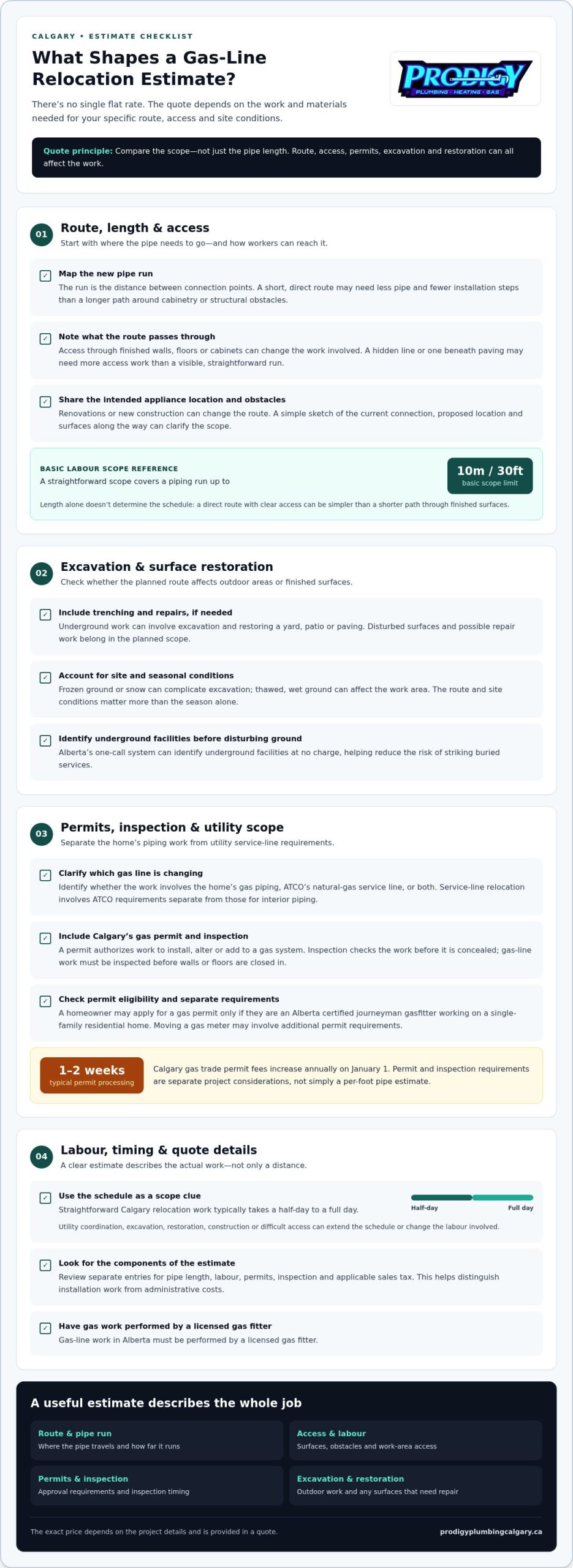
Basic labour scope and piping-run length
Basic labour scope is the work involved in relocating a gas line along its planned piping run. A straightforward Calgary relocation typically takes half a day to a full day. The basic scope covers a run up to 10m/30ft, giving homeowners a useful reference when discussing the planned route with a contractor.
Pipe-run length is the distance the new gas pipe must travel between its connection points. A short, direct route may need less pipe and fewer installation steps than a longer route around cabinetry or structural obstacles. For example, moving an appliance connection a short distance within one room differs from routing pipe across several areas of a home.
Construction plans can change the route. A kitchen renovation may shift an appliance, while a garage rebuild may require a line to pass around or beneath new construction. These changes affect the measured run and how easily the work area can be reached. Share the intended appliance location and any known obstacles when describing the project.
To make the scope easier to understand, mark the current connection and proposed location on a simple sketch. Note whether the route crosses a finished wall, floor, cabinet or exterior area. These details help show where the pipe must travel and where access work may be needed. Compare the sketched route with the 10m/30ft basic labour scope.
Length alone doesn’t determine the schedule. A direct route with clear access can be simpler than a shorter path through finished surfaces. Calgary’s typical half-day to full-day range applies to straightforward relocation work; construction or difficult access can change the labour involved. Before proceeding, make sure the estimate describes the route, access points, and expected work, not just the distance.
Hiring a licensed gas plumber
A licensed gas fitter is a qualified tradesperson authorized to perform gas-line work in Alberta. Gas-line work must be done by a licensed gas fitter, and moving a line isn’t a DIY project because natural gas can be dangerous.
Before choosing a contractor, describe the current connection, proposed location and route. Ask for an estimate that separates labour, materials, permit and inspection requirements. Alberta gas work can involve different scopes, so a clear description helps you compare two or three quotes on the same basis.
The estimate may include a two-hour minimum charge. Ask how the quoted labour relates to the scope, such as a direct move within one room versus routing pipe through finished walls.
- Confirm the estimate describes the proposed route and piping-run length.
- Check that permit and inspection steps are accounted for.
- Clarify what happens if access or construction conditions change the scope.
Proper planning includes scheduling an inspection before walls or floors are closed. In Calgary, gas-line work must be inspected before those areas are concealed. Keep the inspection in the schedule, and make sure the estimate identifies who handles permit arrangements and provides access for inspection.
For a kitchen project that also involves a new appliance, coordinate the planned location with kitchen appliance installation so the work scopes are clear.
Prodigy Mechanical: Fixture Swaps
Prodigy Mechanical can help with plumbing work around a kitchen or bathroom renovation. If a gas-line move is part of a wider upgrade, include related fixture and plumbing work as a separate part of the project scope.
Prodigy Mechanical’s Fixture Swaps, Kitchen Plumbing, and Bathroom Plumbing services can support changes to sinks, taps, and other plumbing fixtures. Commercial Plumbing addresses plumbing needs in business settings. Clearly scoping these tasks helps coordinate the renovation without confusing fixture work with gas-line permits or inspection.
Gas piping must be handled by a licensed gas fitter, as required in Alberta. Contact Prodigy Mechanical to discuss related fixture or plumbing work, or visit prodigyplumbingcalgary.ca.
Plan the next step with confidence
Planning the cost to move a gas line in Calgary is easier when you settle the new appliance or fixture location before construction begins. Mark what is changing and what needs to remain accessible. This gives the licensed gas fitter a clearer picture of the intended layout and helps keep related renovation decisions organized.
Keep gas work distinct from other plumbing tasks in your project plan. If the renovation also involves a fixture change or kitchen or bathroom plumbing, Prodigy Mechanical can help with those related parts of the work. The price of plumbing work depends on its scope and is provided in a quote.
For help with related fixture or plumbing work, contact Prodigy Mechanical. A well-planned project can make the next steps feel much more manageable.
Frequently Asked Questions
How much does it cost to move a gas line in Calgary?
There is no single price for every Calgary gas-line move. The estimate depends on the route, pipe length, access, labour, and whether excavation or surface restoration is needed. For example, routing a line through finished cabinetry can involve different access work than installing one along an open utility area. A project-specific quote is the clearest way to understand the full scope and price.
What factors affect the cost of relocating a gas line in Calgary?
The route and site conditions shape relocation costs. A longer run needs more piping, while finished walls, floors, or cabinets can require extra access work. Underground routes may also involve excavation and repairs to disturbed landscaping or paving. Before requesting an estimate, note the appliance’s new location and any nearby construction. These details help describe the work accurately.
Are permits required to move a gas line in Calgary, Alberta?
Yes. Calgary requires a gas permit to install, alter, or add to a gas system, so relocation falls within that scope. The work also requires inspection before walls or floors are closed in. A homeowner may apply only if they are an Alberta certified journeyman gasfitter working on a single-family residential home. Moving a gas meter has a separate permit requirement.
Who is licensed to move or alter gas lines in Calgary?
A licensed gas fitter is required to perform gas-line work in Alberta. A general plumbing qualification alone doesn’t establish authorization for gas work, so confirm that the person handling the gas portion is a licensed gas fitter. This applies to a small appliance connection as well as a larger renovation. Gas piping isn’t suitable for DIY work because natural gas can be dangerous.
Does ATCO Gas need to disconnect, reconnect, or inspect a relocated gas line?
ATCO’s role depends on whether the proposed work affects its natural-gas service line or meter, rather than only piping inside the home. Have the gas fitter identify which part is being moved and coordinate any utility-side work with ATCO. A utility connection and the City of Calgary’s permit inspection are separate considerations, so don’t assume one replaces the other.
How much do gas-line permits and inspections cost in Calgary?
Permit and inspection charges are separate from the contractor’s labour and materials. Treat them as distinct estimate line items, and check that the permit type matches the work. A meter relocation has its own permit requirement, while trade permit fees change annually on January 1. Separating these charges makes it easier to understand the project total and compare estimates with the same scope.