

For gas line repair Calgary homeowners should start with safety, not a wrench. If you notice a rotten-egg smell, hear hissing near a gas line, or suspect an unsafe appliance connection, treat it seriously. Leave the building, avoid switches and phones inside, and call 9-1-1 or ATCO Gas at 1-800-511-3447 from a safe location. Don’t attempt to inspect or repair the line yourself.
It’s natural to worry about how urgent the problem is, what a repair will involve, and whether the work will disrupt your home. This guide explains how to recognize possible gas-line trouble, what to do before a technician arrives, and what a professional diagnosis and repair can involve. The right next step depends on the line’s condition, so a careful assessment helps determine whether repair or replacement is appropriate. Prodigy Mechanical provides gas service for Calgary homes, businesses, and strata properties, with licensed technicians and more than 15 years of industry experience.
Key Takeaways
- Distinguish a suspected gas emergency from a non-urgent concern, and follow safe steps before arranging an assessment.
- For gas line repair Calgary, a qualified technician’s diagnosis helps determine the work needed instead of relying on a visual guess.
- Repair or replacement depends on the line’s condition, access, and scope of work, not age or one symptom alone.
- Permit and inspection requirements depend on the work, so understand the applicable Calgary requirements before work begins.
- Prodigy Mechanical’s licensed technicians assess gas-line concerns and explain the proposed scope for residential, commercial, and strata properties.
Gas Line Repair in Calgary: Signs and What to Do
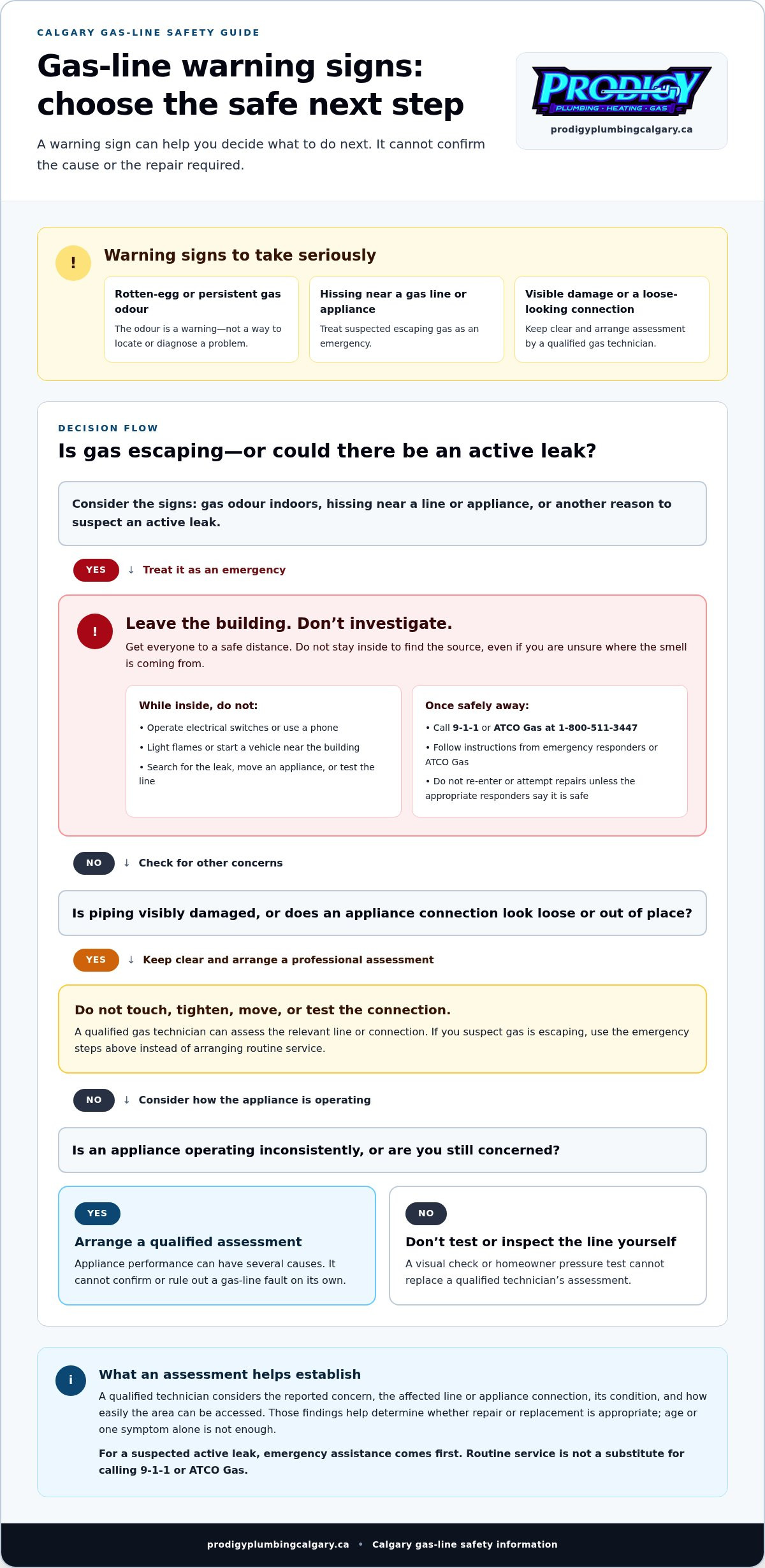
First, separate a possible gas emergency from a repair concern that can be assessed through routine service. A gas odour indoors, hissing near a line or appliance, or a suspected active leak calls for immediate action. Leave the building and contact emergency help from a safe location. Don’t stay inside to investigate, even if you’re unsure where the smell is coming from.
Other concerns, such as visibly damaged piping or an appliance connection that looks loose, still deserve prompt attention. Don’t touch, tighten, or test the connection. Arrange an assessment by a qualified gas technician. Appliance problems, including inconsistent operation, can have several causes, so performance alone can’t confirm or rule out a gas-line fault.
Natural gas is given a distinctive odour to help people notice a possible leak. That odour is a warning, not a way to locate or diagnose the problem. The Natural Gas Overview describes natural gas and its properties, but a qualified professional must assess a suspected issue on site.
Which gas-line warning signs deserve prompt attention?
Pay attention to a persistent gas odour, visible damage to accessible piping, or an appliance connection that appears out of place. A concern can be urgent even when you can’t see damage. Don’t move an appliance to inspect behind it or use a flame to check for a leak. If you suspect gas is escaping, treat it as an emergency. If there’s no indication of an active leak, keep clear of the area and arrange professional service.
For gas line repair Calgary residents should rely on a qualified technician’s assessment, not a visual guess or a homeowner pressure test. A warning sign helps you decide what to do next; it doesn’t establish the cause or the repair required.
What should Calgary residents do if they suspect a gas leak?
Act promptly and keep the steps simple:
- Leave the building immediately and get everyone to a safe distance.
- Don’t operate electrical switches, use a phone inside, light flames, start a vehicle near the building, or search for the leak.
- Once you’re safely away, call 9-1-1 or ATCO Gas at 1-800-511-3447.
- Follow instructions from emergency responders or ATCO Gas. Don’t re-enter or attempt repairs unless the appropriate responders say it’s safe.
Key takeaway: A suspected gas leak requires evacuation and qualified emergency assistance, not DIY investigation. Booking routine service is not a substitute for calling 9-1-1 or ATCO Gas when a leak may be present.
How a Professional Gas Line Repair in Calgary Is Diagnosed and Completed
A reliable repair starts with understanding the concern, not guessing at the cause. A qualified gas technician discusses what you’ve noticed, identifies the relevant gas line or appliance connection, and assesses the affected area. The line’s condition, the connection involved, and how easily the area can be accessed all help shape the work plan.
Diagnosis establishes the work scope before repair begins. This gives you a clear basis for deciding how to proceed and helps distinguish a localized issue from one that may need a broader solution. A homeowner’s visual check or pressure test can’t replace a qualified technician’s assessment.
What happens during a gas-line assessment?
The technician starts with your description of the issue, including where you noticed it and which appliance or area may be involved. They then inspect the relevant part of the gas service and consider the condition of connected equipment. Access matters too: a line behind an appliance or in a hard-to-reach area may affect how the work is approached.
The assessment focuses on the reported concern and what can be observed on site. It doesn’t rely on a homeowner trying to reproduce a problem or test the line. For broader background on safety in Canada’s natural gas industry, see Canadian Natural Gas Industry Safety.
How are repair options and work approval handled?
After assessing the area, the technician explains the findings and recommended scope in plain language. You can discuss what the proposed work addresses and how access or connected equipment may affect the approach. The goal is to make the next step clear before work begins, including what is being repaired.
At Prodigy Mechanical, licensed technicians handle gas service work for Calgary residential, commercial, and strata properties. Service is billed per job, and the proposed scope is discussed before proceeding. Once you agree on the work, the technician completes the authorized repair and explains what was addressed and any relevant next steps.
For example, a concern at one appliance connection may call for a different scope from a problem involving a longer section of piping. The technician’s assessment helps establish which situation applies rather than assuming every symptom calls for the same repair. Prodigy Mechanical brings more than 15 years of industry experience to gas service in Calgary.
To learn about professional gas-line repair in Calgary, share what you’ve observed to start a focused assessment. For a suspected active leak, contact emergency assistance first rather than arranging routine service.
Gas Line Repair or Replacement: How the Right Scope Is Determined
A gas-line concern doesn’t automatically mean the whole line needs replacing. The right scope depends on the technician’s findings, including the affected section’s condition, its connections, and how it can be reached. Age alone or one symptom isn’t enough to decide. A careful assessment connects the proposed work to the actual condition of the gas system and the property’s needs.
Repair addresses an identified fault, while replacement changes a defined section or system. That distinction is a starting point, not a fixed rule. A localized repair may be appropriate in one situation, while broader work may be considered if the assessment finds concerns beyond the visible problem.
| Localized repair | Broader replacement | |
|---|---|---|
| Condition | A limited, identifiable fault may be addressed on its own if the surrounding line is in suitable condition. | Multiple concerns or broader deterioration may lead the technician to assess a larger section. |
| Access | A reachable fault may allow focused work, depending on the line and nearby connections. | Concealed or difficult-to-reach piping can affect the work plan and how much area must be accessed. |
| Disruption | Work may be more contained, though access and property layout still matter. | A wider scope may require more access to the affected area and could create more disruption. |
| Work addressed | Corrects a specific fault identified during assessment. | Replaces a defined section or, where findings support it, a broader part of the system. |
When might a localized gas-line repair be suitable?
A focused repair may be considered when the technician identifies a limited fault and assesses the surrounding line as part of the visit. Safe access matters, as does the condition of nearby piping and connections. A concern at one connection doesn’t automatically mean that connection can be repaired in isolation. The technician determines whether localized work responsibly addresses the finding.
When might a broader replacement be considered?
Multiple problem areas, signs of deterioration, or a section that can’t be assessed without additional access may prompt consideration of broader replacement. The scope should reflect what the technician finds, how the gas line serves the property, and what work is needed to address its condition. Repeated concerns in one area may also be relevant, but they don’t establish a replacement decision by themselves.
Ask for the proposed scope to be explained in practical terms: which section is affected, why the work is recommended, and what access may be required. Piping behind a finished surface, for example, may involve different access considerations from an exposed line. The assessment should account for this before work proceeds, so the expected area of disruption is clear.
For gas line repair Calgary property owners should expect recommendations to follow the findings, not a preset rule based on age or a single symptom. A qualified technician can explain whether the identified fault supports a localized repair or whether the condition and access call for broader replacement.
Calgary Gas-Line Service: Safety, Local Requirements, and Preparing for a Visit
Gas-line work in Calgary can involve local and provincial requirements, but the permits or inspections that apply depend on the work. Before work begins, check requirements against current official guidance rather than assuming they are the same as for another property’s project. The City of Calgary provides local information, while Alberta’s safety-code resources, including the Alberta Safety Codes Council, offer provincial context. ATCO Gas is Calgary’s natural gas utility and a separate point of contact for utility-related concerns.
Which local requirements should property owners consider?
Installation, alteration, and repair work may not all follow the same requirements. Applicable permit and inspection obligations depend on the scope and should be verified using current City of Calgary and Alberta guidance. Avoid relying on old advice or requirements for a neighbouring municipality. A utility emergency response is also different from a scheduled repair appointment: if there may be an active gas leak, contact emergency assistance or ATCO Gas from a safe location rather than waiting for routine service.
For broader information about home systems and service planning, the Calgary plumbing and heating guide provides useful context. It doesn’t replace current official direction for gas-line work, but can help you understand how plumbing and heating needs fit into maintaining a Calgary property.
How can you prepare for a Calgary gas-line service visit?
For a non-emergency assessment, a few details can help focus the visit. Share the property address, the affected appliance or area, what you’ve noticed, and when the concern began. Mention relevant appliance changes, renovations, or earlier work near the line. If the piping is difficult to reach, explain where it runs or what may be in the way. Don’t move equipment or disturb the area to improve access.
- Identify the appliance or part of the property involved.
- Describe the concern without attempting to test or repair the line.
- Point out access limits, such as stored items or finished surfaces, if it’s safe to do so.
- Keep the work area accessible only when there’s no suspected leak or other immediate danger.
If the concern is an urgent plumbing issue rather than a suspected gas leak, the Calgary emergency plumbing guide explains how to approach that kind of service request. For gas line repair Calgary property owners can prepare by sharing clear details and leaving the technical assessment to a qualified technician. For a non-emergency concern, learn about Prodigy Mechanical’s gas-line service.
Arrange Gas Line Repair in Calgary with Prodigy Mechanical
Once a gas-line concern has been assessed, the next steps should be clear: understand the findings, review the proposed work, and decide how to proceed. Prodigy Mechanical provides gas service in Calgary for residential, commercial, and strata properties. Licensed technicians handle gas installations and repairs, drawing on more than 15 years of industry experience across plumbing, heating, and gas services.
A straightforward request helps start the process. Share what you’ve noticed and where the concern is located. The team can arrange an assessment, explain the recommended scope, and proceed with the work you approve. Whether the concern involves an appliance connection or a section of piping, the proposed work is based on the property and the technician’s findings.
What can customers expect from Prodigy Mechanical?
Expect a methodical approach and clear communication. The technician assesses the reported concern, explains the findings in plain language, and discusses the proposed work before proceeding. Scope is tailored to the property rather than assumed in advance. Work is billed per job, with job details discussed as part of the service process so you can understand what the proposed work covers before authorizing it.
What information helps start a gas-line repair request?
When arranging non-emergency service, provide the property address, the affected area or appliance, and a brief description of the concern. Mention whether the property is residential, commercial, or strata, and include relevant context such as recent appliance changes or renovations. You don’t need to diagnose the issue; those details simply help direct the assessment.
The process can be summarized in four steps:
- Describe the location and nature of the concern.
- Arrange an assessment for the property.
- Review the technician’s findings and proposed scope.
- Proceed with the work you’ve agreed to.
If you suspect an active gas leak, don’t use a booking form or wait for a routine appointment. Leave the building, avoid operating switches or using flames, and call 9-1-1 or ATCO Gas from a safe location. Emergency response takes priority over scheduling a repair assessment.
For non-emergency gas line repair Calgary property owners can begin with a clear description of the issue and the property type. Prodigy Mechanical’s licensed technicians provide gas service for local homes, businesses, and strata properties, with careful diagnosis and communication throughout the work.
Request gas-line service from Prodigy Mechanical to arrange an assessment and discuss the next steps for your property.
Take the Next Step with Confidence
A gas-line concern can feel uncertain until you know what needs attention. For a non-emergency issue, arrange a professional assessment and note the location, what you’ve observed, and any recent changes near the line. That gives the technician a useful starting point and keeps the conversation focused on your property’s needs.
With gas line repair Calgary service, a clear explanation of the findings and proposed scope can help you decide how to proceed without guesswork. Discuss the work before it begins and move ahead with an agreed plan. If you suspect an active gas leak, leave the property and call emergency assistance from a safe location instead of using a routine service request.
Prodigy Mechanical provides gas service for Calgary homes, businesses, and strata properties. Learn more about gas-line service from Prodigy Mechanical.
Frequently Asked Questions
How much does gas line repair cost in Calgary?
Gas-line repair costs in Calgary depend on the diagnosed fault and the work needed to reach it. Prodigy Mechanical bills gas services per job, not at one universal rate. After assessment, the proposed scope is explained before you decide whether to proceed. A concern at an accessible appliance connection may involve different work from piping behind a finished wall, so the job details matter.
Can I repair a gas line myself?
No. Gas-line work in Alberta must be handled by a qualified, certified gasfitter. DIY work can create serious safety hazards and may affect your home insurance. Don’t tighten fittings, disconnect appliances, or use a flame to investigate. If you suspect gas is escaping, leave the property and seek emergency assistance from a safe location. For a non-emergency concern, arrange a professional assessment.
Is a gas smell always a sign of a gas leak?
No. An odour alone can’t confirm the source, but a rotten-egg smell indoors can indicate natural gas because an odorant is added to help people detect it. Don’t try to identify the source yourself or dismiss the smell because it comes and goes. Leave the building and call 9-1-1 or ATCO Gas from a safe location if you suspect a leak.
How long does gas line repair take?
There isn’t one reliable timeframe for every repair. The duration depends on the fault, the approved scope, and how accessible the affected piping is. Work involving a concealed section may require a different plan from an issue at an exposed connection. A technician can discuss the expected work after assessing the property, so you can plan around the specific job rather than rely on a generic estimate.
Can a damaged gas line be repaired without replacing the whole line?
Yes, a localized repair may be suitable if the technician identifies a limited fault and finds the surrounding line is in appropriate condition. Broader deterioration, more than one affected area, or difficult access may change the recommendation. A visible problem at one connection, for example, doesn’t establish the condition of piping behind a wall. The technician’s findings determine whether focused repair or replacement is appropriate.
Do gas line repairs in Calgary require a permit or inspection?
Requirements depend on the work’s scope. The City of Calgary requires a gas permit for installation, alteration, or addition to a gas system; whether a particular repair falls into those categories depends on the work involved. Applicable inspection requirements also vary. A licensed contractor is responsible for obtaining required permits. Check current City of Calgary guidance for the specific project before work begins.
For a non-emergency gas-line concern, request gas-line service from Prodigy Mechanical to arrange an assessment and discuss the appropriate next steps for your Calgary property. If you suspect a gas leak, leave the building and call 9-1-1 or ATCO Gas from a safe location.